

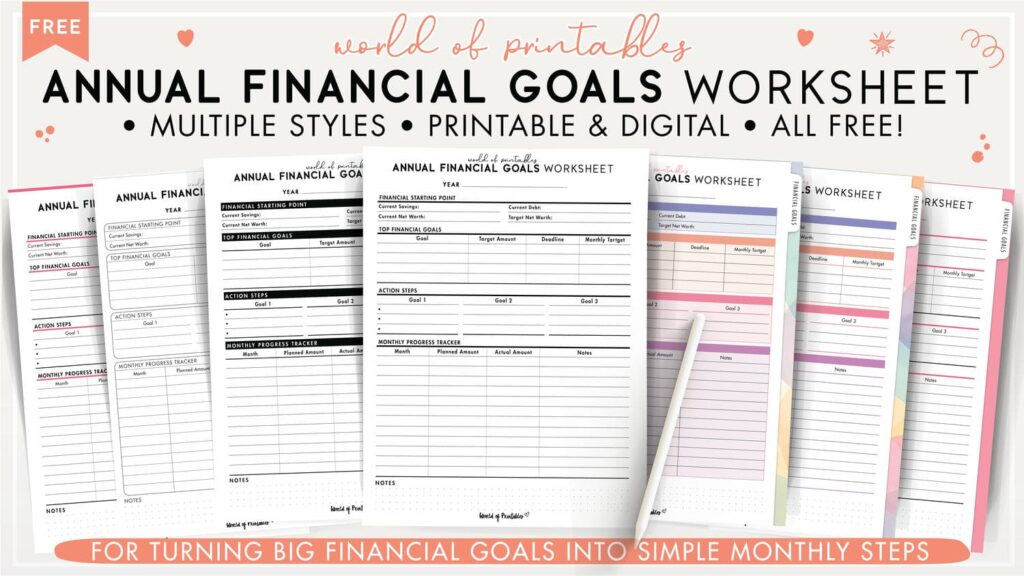
Disclaimer: We provide high-quality, free printable templates to help you organize your personal data. We are not certified financial planners or investment advisors. The tools and information provided below are for educational and organizational purposes only. Always consult a licensed financial professional before making high-stakes decisions regarding investments, asset allocation, tax strategy, or debt consolidation.
A monthly budget helps you manage the next few weeks. An annual financial plan helps you decide where your money is actually going.
That difference matters, because if you only ever plan one month at a time, it is very easy to stay busy with your money without making meaningful progress. Bills get paid, groceries get bought, life keeps moving, but bigger goals stay vague. Savings feel slow. Debt takes forever. Long-term plans get pushed off “until things calm down.”
That is exactly why an Annual Financial Goals Worksheet is so useful.
This printable gives you a place to step back, look at the bigger picture, and decide what you want your money to do for you over the next year and beyond. Instead of reacting month by month, you start with clear goals and build your budget around them.
If you are putting together a budget binder, this is one of the best pages to start with.
What is an Annual Financial Goals Worksheet?
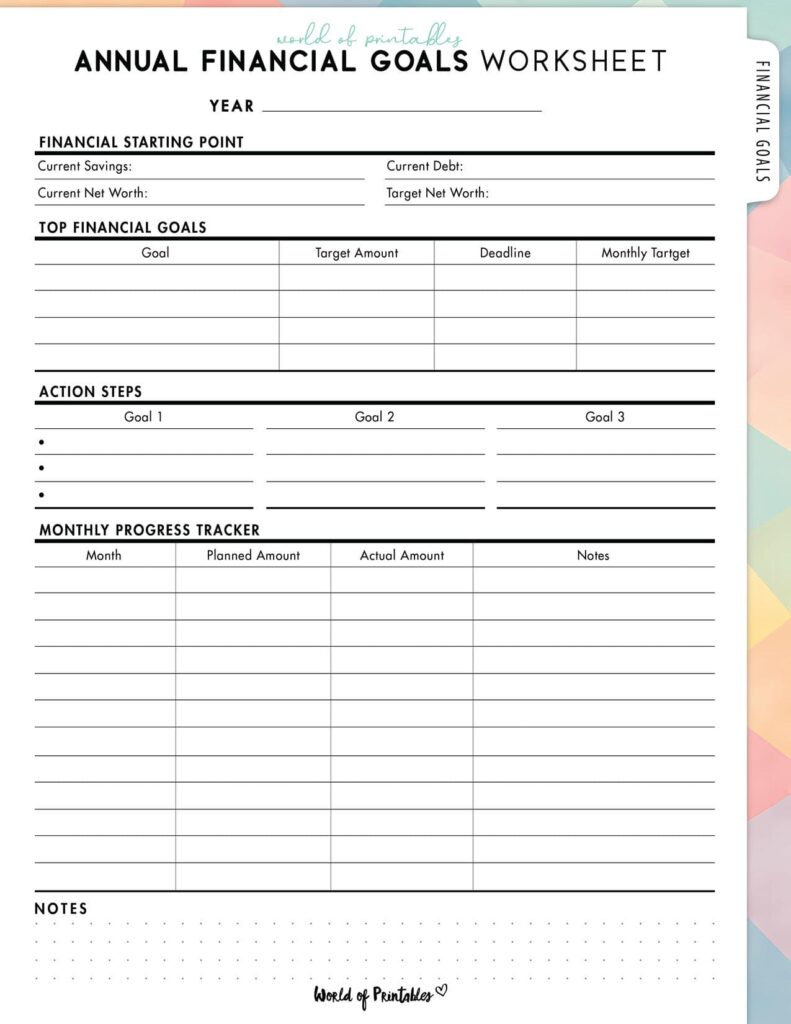
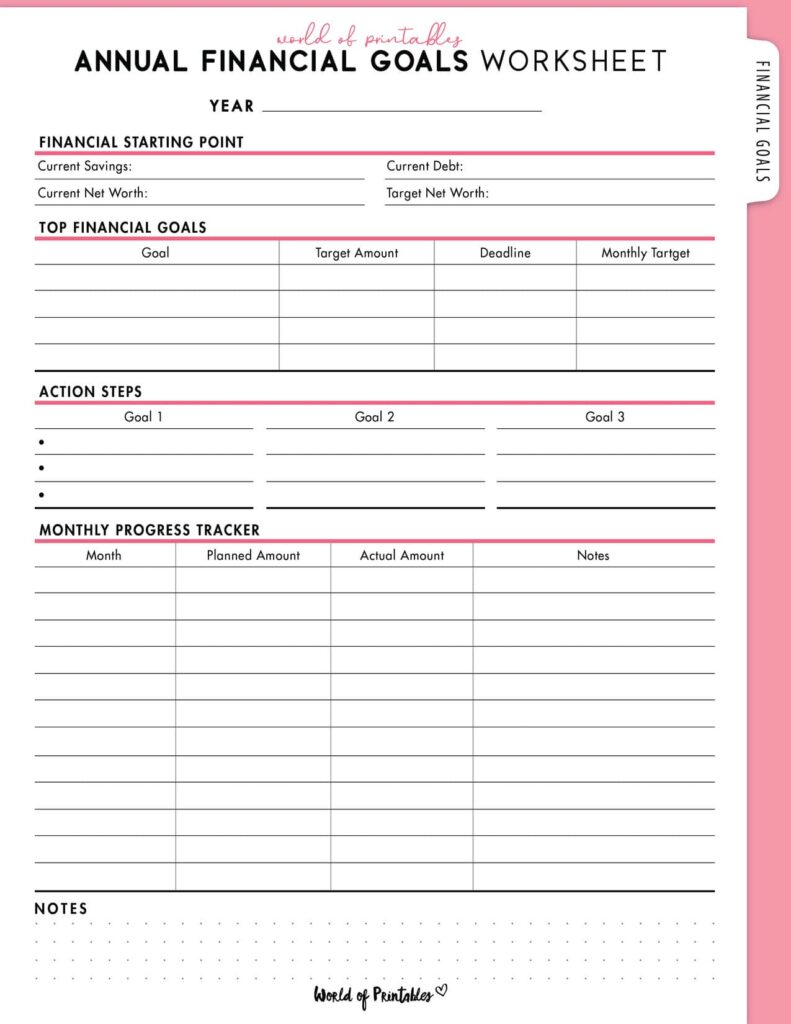
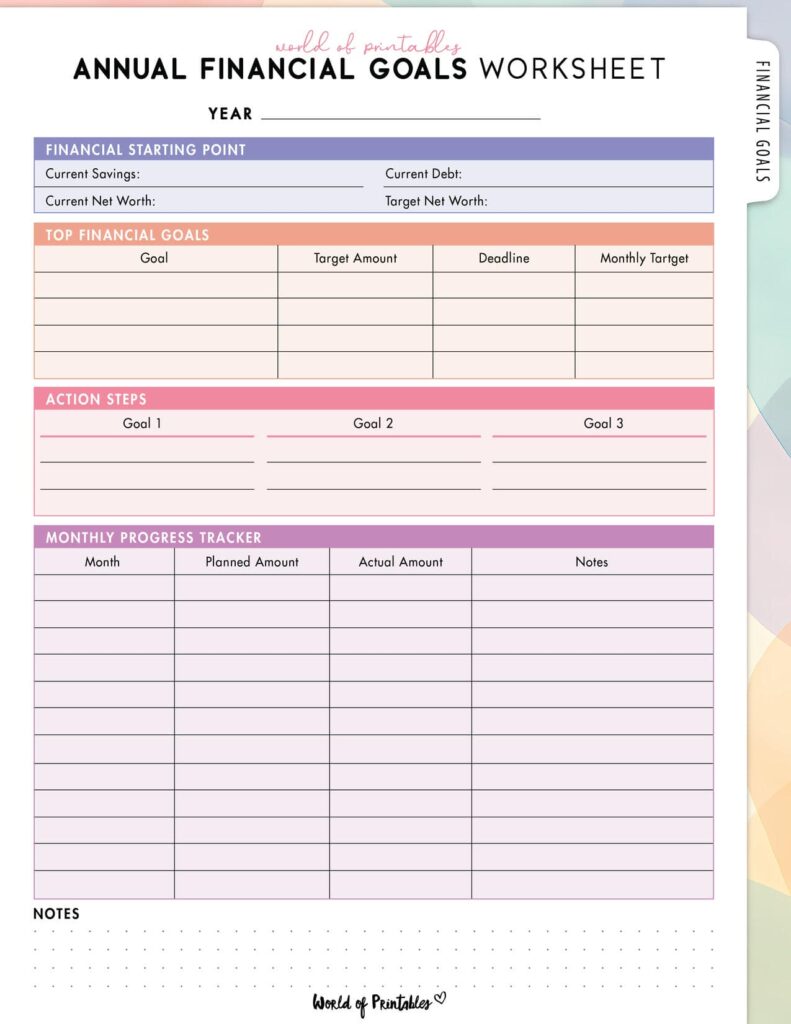
An Annual Financial Goals Worksheet is a printable designed to help you map out your main financial goals for the year ahead.
It gives you space to define your priorities across different timeframes, such as:
- short-term goals for the next 12 months
- medium-term goals for the next 3 to 5 years
- long-term goals for retirement, wealth building, or major life plans
It is not your monthly budget, it is the page that gives your monthly budget direction.
Without this kind of page, it is easy to build a budget around whatever feels urgent right now. With it, you can start making choices that support the future you actually want.
Why this printable matters
A lot of people budget carefully each month but still feel like they are not moving forward.
That usually happens because there is no clear plan above the monthly level.
When you set annual financial goals, you can start answering questions like:
- What am I actually saving for this year?
- Which debt should I focus on first?
- How much do I want in my emergency fund?
- What bigger money goals matter to me over the next few years?
- What would real progress look like by the end of this year?
This kind of clarity changes how you use your money.
Instead of simply managing what comes in and goes out, you begin giving your money a job that connects to something bigger.
Choose a design theme that fits your style
This printable comes in a range of layouts so you can choose the one that works best for your budget binder and planning style.
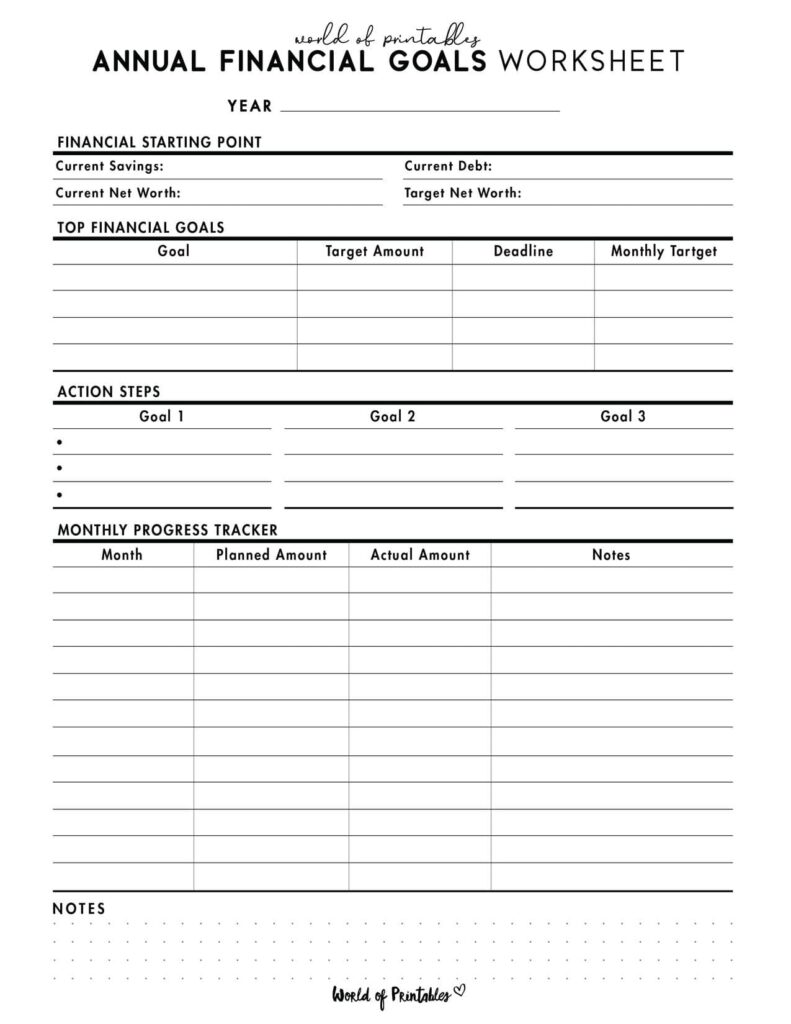
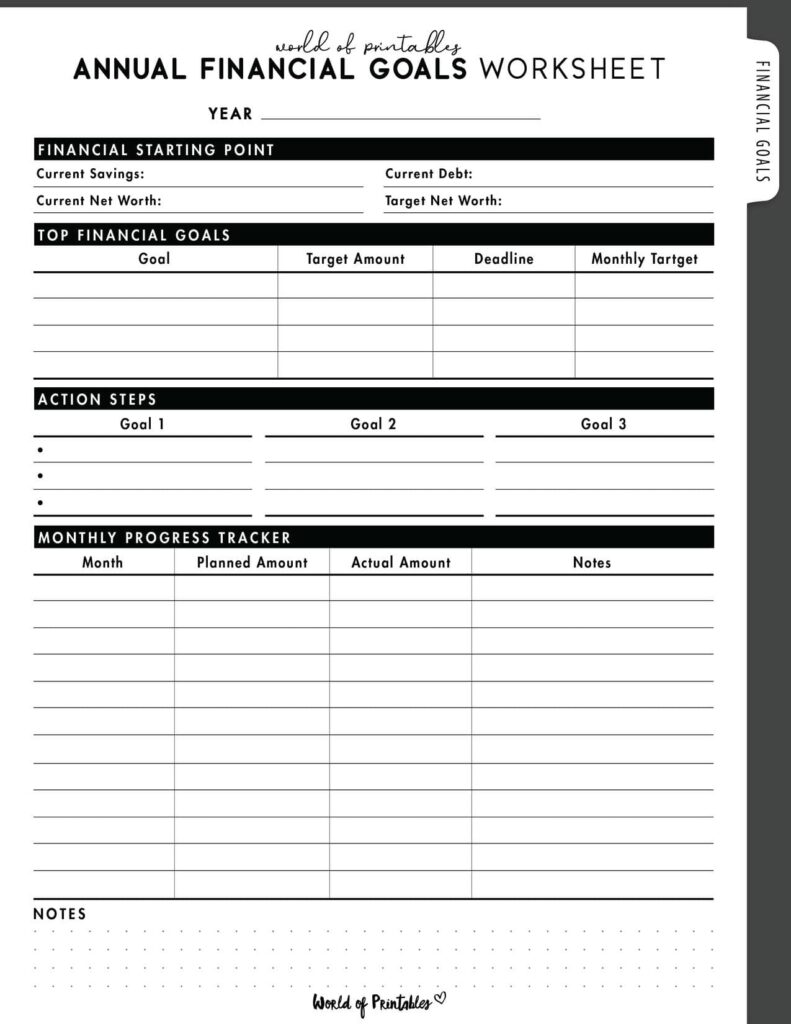
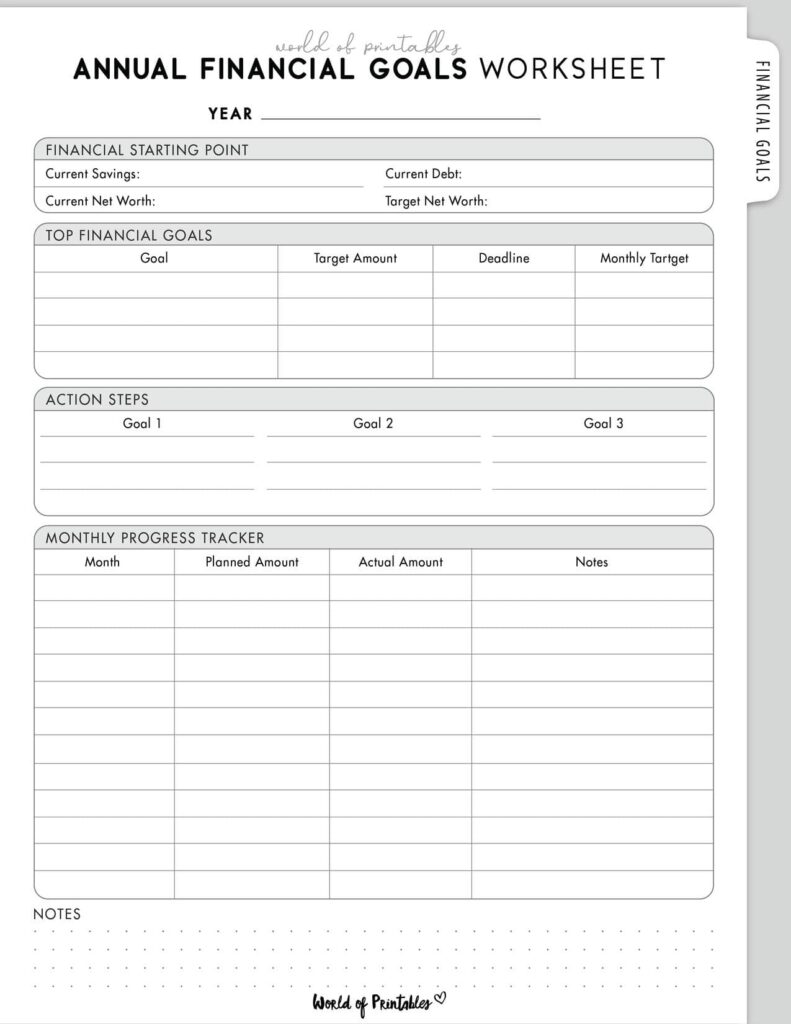
Minimalist and simple styles
These are ideal if you want a clean, structured page that keeps all the attention on your goals and numbers.
They work especially well if you prefer a more professional looking budget binder.
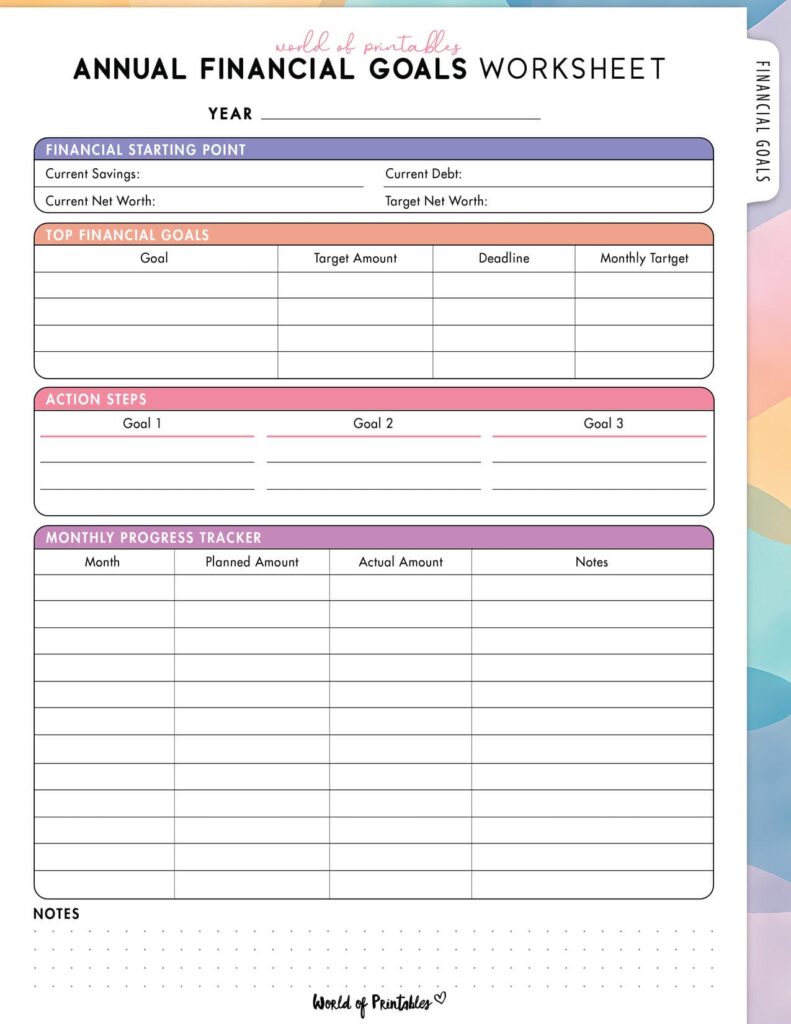
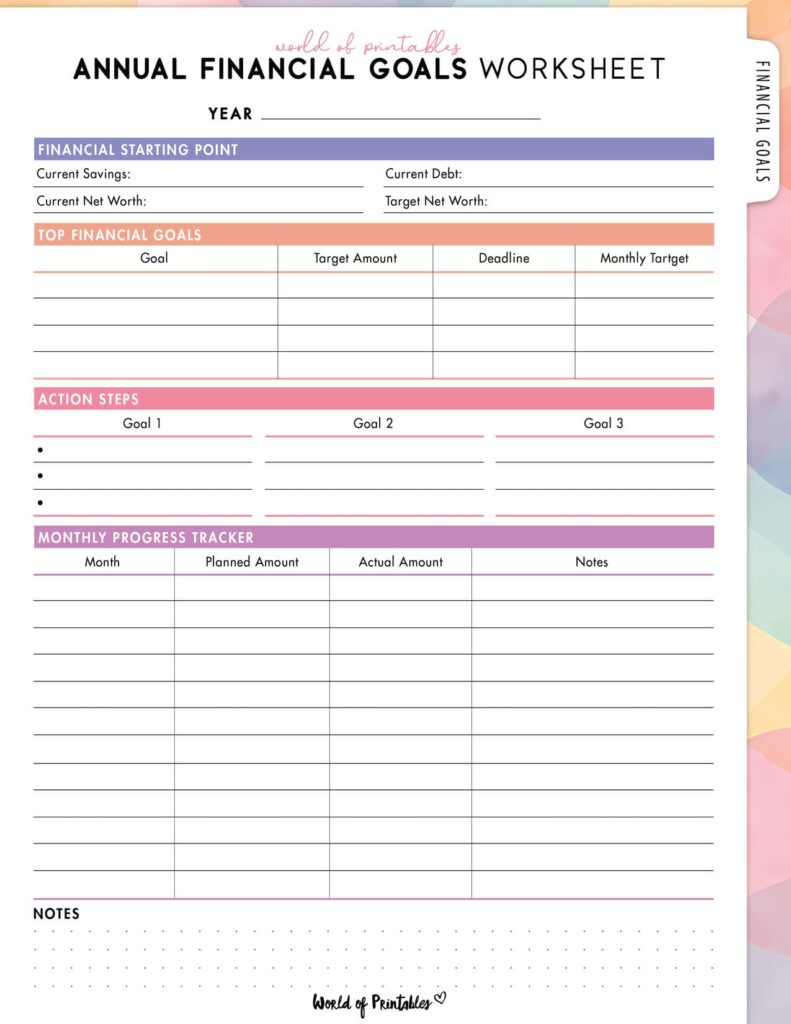
Colorful and visual styles
These are great if you like visual separation between your short-term, medium-term, and long-term goals.
They can make the page easier to read at a glance and help each section feel distinct.
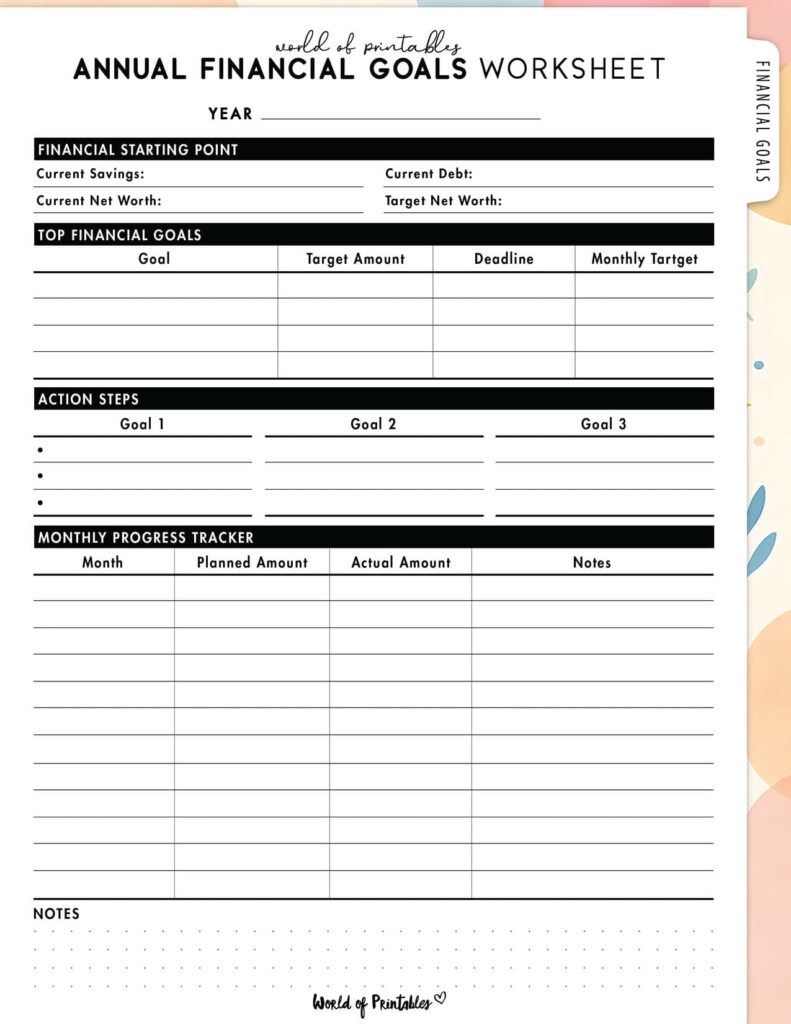
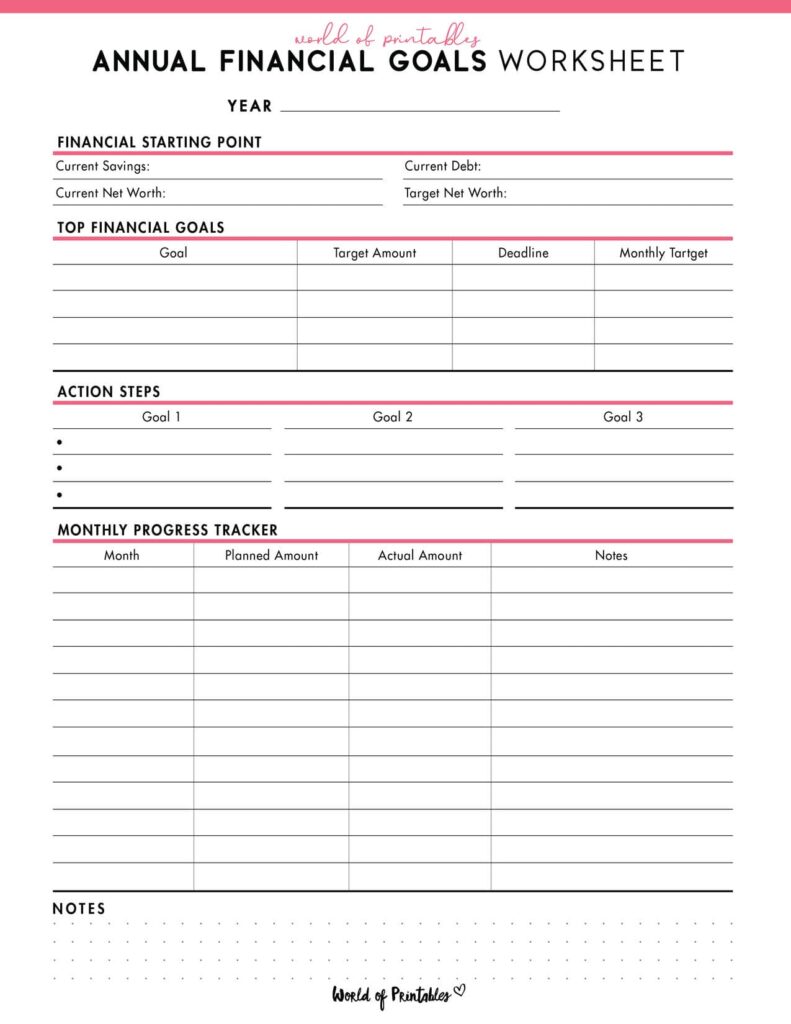
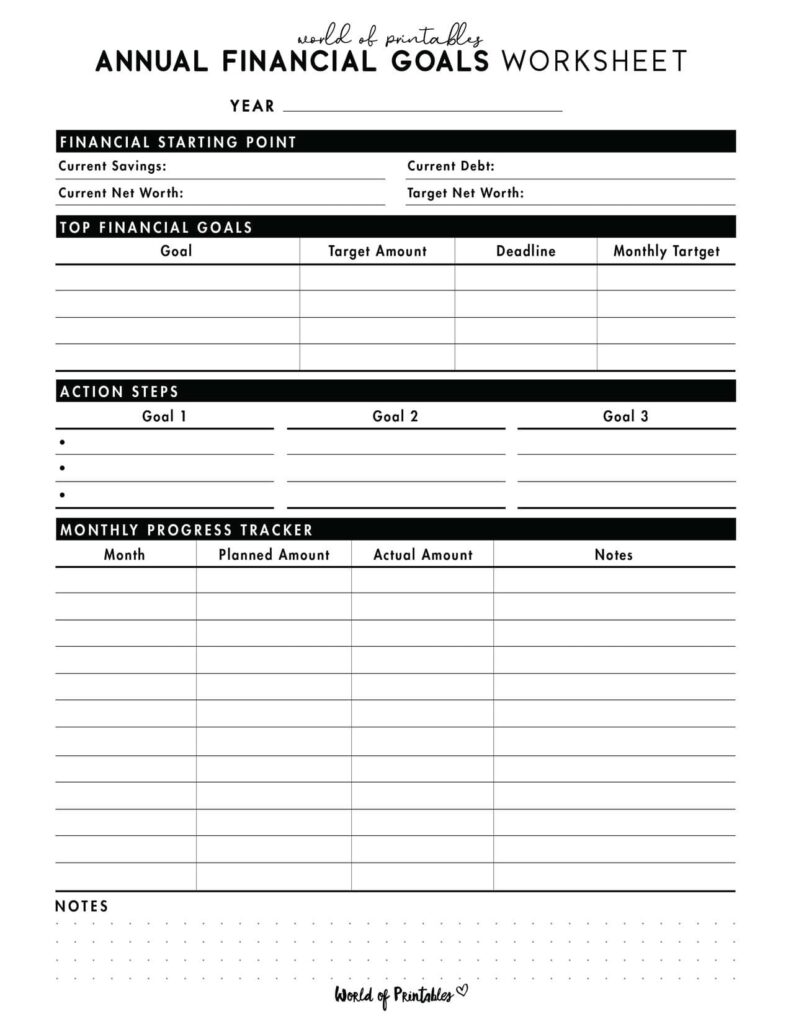
Ink-saving options
If you print a lot of planner pages, these are a practical choice.
They still look polished and organised, but use less colour ink while keeping the layout clear and easy to use.
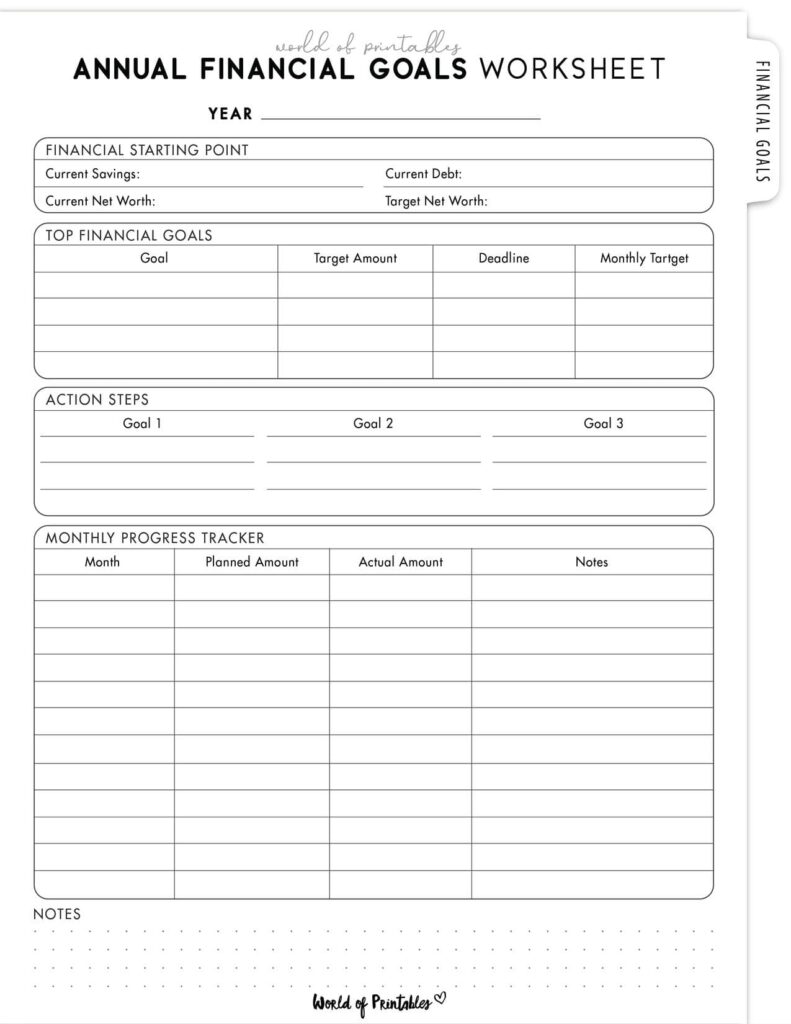
Free Download and Printing Instructions
To download your free Annual Financial Goals Worksheet, click the text link directly beneath the image of your preferred design. This will open the high-resolution PDF.
For the best results:
- download the PDF directly to your device
- open the document and select Print
- make sure your printer is set to US Letter
- choose Fit to Page or Scale to Fit so the margins print correctly
Because this is a page you will likely refer back to all year, it can be worth printing it on a slightly thicker paper for a more durable feel.
A premium 28 lb or 32 lb paper works especially well in a budget binder.
Why this page should go at the front of your budget binder
If you use a budget binder, your Annual Financial Goals Worksheet works best as one of the first pages.
That is because it acts like the blueprint for the rest of your system.
Your budget pages, savings trackers, debt payoff printables, and sinking funds all work better when they are supporting clearly defined goals.
Think of it this way:
- your annual goals worksheet sets the direction
- your monthly budget handles the execution
- your trackers show the progress
When those pieces work together, your binder feels much more intentional and useful.
How to Use an Annual Financial Goals Worksheet
This is a fantastic “big picture” printable! For a typical family, juggling paying off a chunk of debt while trying to build an emergency fund and save for a fun family memory (like a Disney trip) is incredibly relatable.
This printable is easiest to complete at the beginning of a new year, but you can start at any point.
Here is a highly realistic, motivating example to show you exactly how to use this worksheet for a successful financial year.
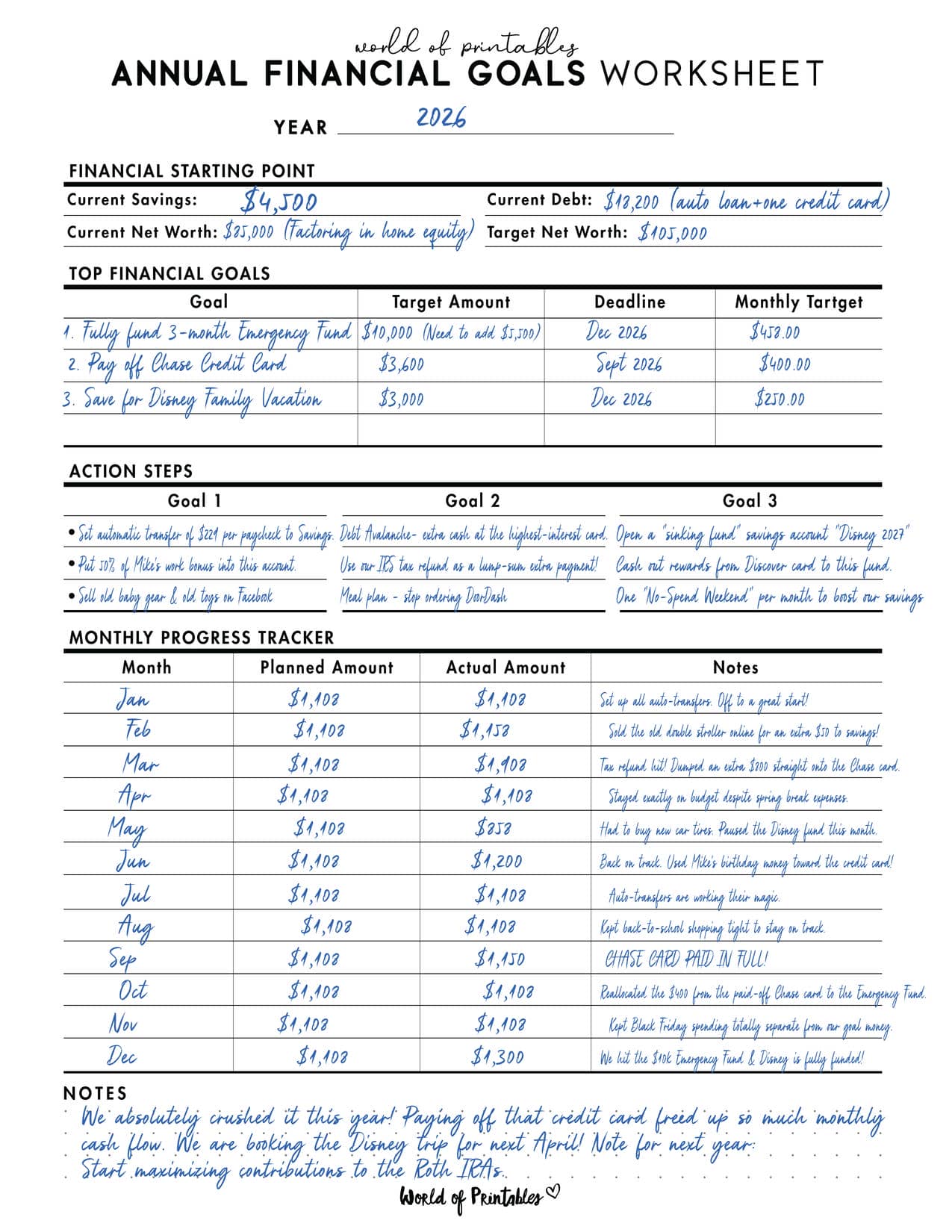
Here is the best way to fill it out:
Step 1: Define your short-term goals
Start with the goals you want to focus on over the next 12 months.
These are usually the goals that improve stability, reduce stress, or help you gain traction quickly.
Examples might include:
- build or complete an emergency fund
- pay off a credit card
- save for a planned expense
- increase your monthly savings amount
- catch up on overdue bills
- make an annual contribution to a savings or investment account
Short-term goals should feel specific and measurable.
Instead of writing:
- “save more money”
Try:
- “save $3,000 for emergency savings”
- “pay off $,400 in credit card debt”
- “save $1,200 for Christmas and birthdays”
The clearer the number, the easier it is to build a plan around it.
Step 2: Map out your medium-term goals
Next, think about the financial goals that may take a few years rather than a few months.
This is where you focus on bigger projects and lifestyle goals.
Examples might include:
- save for a house deposit
- buy a car with cash
- become debt-free
- build a larger emergency fund
- save for a major home project
- prepare financially for a family change
These goals usually need more time and more planning, which is exactly why writing them down matters.
Even if the goal is not happening this year, it still deserves a place in your financial system so your current choices can start supporting it.
Step 3: Set your long-term goals
Long-term goals are the goals that shape your bigger financial future.
They often include things like:
- retirement savings
- mortgage payoff
- long-term investing
- financial independence
- a target net worth
- building lasting household stability
These goals can feel distant, which is why people often ignore them. But putting them on paper makes them feel more real and more connected to the decisions you are making now.
You do not need to have every detail perfectly figured out. You just need to start identifying the direction you want your finances to move in over time.
Step 4: Break the maths down into monthly action
This is the part that turns a wish into a plan.
Once you have your short-term financial goals, divide them into smaller targets.
For example:
- $1,200 savings goal over 12 months = $100 per month
- $2,400 debt payoff goal over 12 months = $200 per month
- $600 annual sinking fund target = $50 per month
This is where your worksheet starts informing your monthly budget.
Instead of wondering what to do with extra money each month, you already know what your priorities are and how much needs to go toward each one. That makes budgeting feel more purposeful and less reactive.
What to include on your Annual Financial Goals Worksheet
A good worksheet should help you think clearly without feeling crowded or overly complicated.
Helpful sections may include:
- short-term goals
- medium-term goals
- long-term goals
- target amounts
- target dates
- monthly breakdowns
- notes or motivation
- priority ranking
Some people also like to include a “why” section next to each goal. That can be really helpful, especially for goals that take discipline over time.
When you know why a goal matters, it becomes easier to keep showing up for it month after month.
How this worksheet helps your monthly budget work better
One of the best things about this printable is that it helps your monthly budget make more sense.
Without goals, a monthly budget can become a list of expenses.
With goals, your budget becomes a tool.
It starts answering questions like:
- How much should I put into savings this month?
- Which debt should I focus on first?
- What should my sinking funds cover?
- How much can I spend freely without slowing down my goals?
That is why this page works so well at the beginning of a new year. It helps you start budgeting from a place of strategy rather than guesswork.
Big money goals become much easier to reach when each paycheck is working toward them. Our Paycheck Planner helps you turn longer-term financial goals into a more practical payday-by-payday routine.
A helpful tip before you fill it in
Try not to overload this page with twenty financial goals.
A shorter list of clear, meaningful goals is almost always more useful than a long list of good intentions.
If everything is a priority, nothing is.
Choose the goals that would make the biggest difference to your financial life this year, and let those lead your monthly decisions.
Next Step: Build Your Complete Financial Command Binder
Once you have set your annual financial goals, the next step is making sure your binder supports them properly.
Helpful pages to add next include:
- a net worth tracker
- a monthly budget planner
- a savings tracker
- a debt payoff tracker
- sinking fund printables
- a year-end financial summary
Together, these pages help you go from setting goals to actually tracking the progress that gets you there.
Your Annual Financial Goals Worksheet gives your budget binder direction. Keep optimizing your wealth-building system by adding the next essential tools to your binder:
- Return to the Ultimate Budget Binder Index.
- You know where you want to go, but where are you starting? Download the Net Worth Tracker to calculate your current baseline.
- Download the Monthly Budget Planner (Zero-Based) to assign your monthly capital to your new annual targets.
More budgeting templates
You’ll find many more budgeting templates right here on World of Printables.




AI TRANSPARENCY: Whilst the majority of our creations have been created completely traditionally, occasionally we utilize AI tools in our design process. We acknowledge the advancements in AI technology and leverage them responsibly to optimize our creative output. However, it is important to note that our utilization of AI does not compromise the human element of our work. Our commitment to delivering high-quality designs through a balanced integration of traditional expertise and AI enhancements remains paramount.