

Disclaimer: We provide high-quality, free printable templates to help you organize your personal data. We are not certified financial planners or investment advisors. The tools and information provided below are for educational and organizational purposes only. Always consult a licensed financial professional before making high-stakes decisions regarding investments, asset allocation, tax strategy, or debt consolidation.
Your income tells you what is coming in. Your budget tells you where it is going. But your net worth tells you where you actually stand.
That is why a net worth tracker is such an important part of a budget binder.
A lot of people focus only on monthly budgeting, daily spending, or debt payments. Those things matter, of course, but they only show part of the picture. If you want to understand whether your overall financial position is improving, you need to look at your assets and your liabilities together.
That is exactly what a Net Worth Tracker helps you do.
It gives you one simple place to total what you own, subtract what you owe, and track how that number changes over time. If you want a clearer view of your finances beyond just month-to-month budgeting, this is one of the most useful printables you can add to your system.
What is a net worth tracker?
A Net Worth Tracker is a printable that helps you calculate your overall financial position.
Your net worth is:
Total Assets – Total Liabilities = Net Worth
In simple terms:
- assets are the things you own that have value
- liabilities are the debts and balances you still owe
When you subtract what you owe from what you own, the number left is your net worth.
That number may be positive or negative. Both are normal. What matters most is being able to see it clearly and track the direction it is moving in over time.
Why this printable matters
A lot of financial progress happens slowly, which means it can be easy to miss.
You might be:
- paying down debt
- building savings
- adding to retirement accounts
- increasing home equity
- improving your cash position
But if you only look at your current account balance, you may not feel like much is changing.
A Net Worth Tracker helps by giving you a much bigger view.
It shows:
- the money you have built
- the debt you have reduced
- the overall financial direction you are moving in
That can be incredibly useful, especially if you are working toward bigger goals like debt freedom, savings growth, or long-term financial stability.
A net worth tracker shows the bigger financial picture, but the daily progress happens between paydays. Use our Paycheck Planner to stay on top of bills, spending, savings, and debt while you build your overall financial position month by month.
Why this works so well in a budget binder
A Net Worth Tracker is one of the strongest “big picture” pages you can include in a budget binder.
It works especially well alongside:
- monthly budget planners
- debt payoff trackers
- savings trackers
- annual financial goals worksheets
- year-end financial summaries
Those pages help you manage the day-to-day and month-to-month side of your finances.
Your net worth tracker helps answer the bigger question:
Is all of this actually improving my overall financial position?
That is why this page is so valuable. It helps connect your daily habits to your long-term results.
Choose a design theme that fits your style
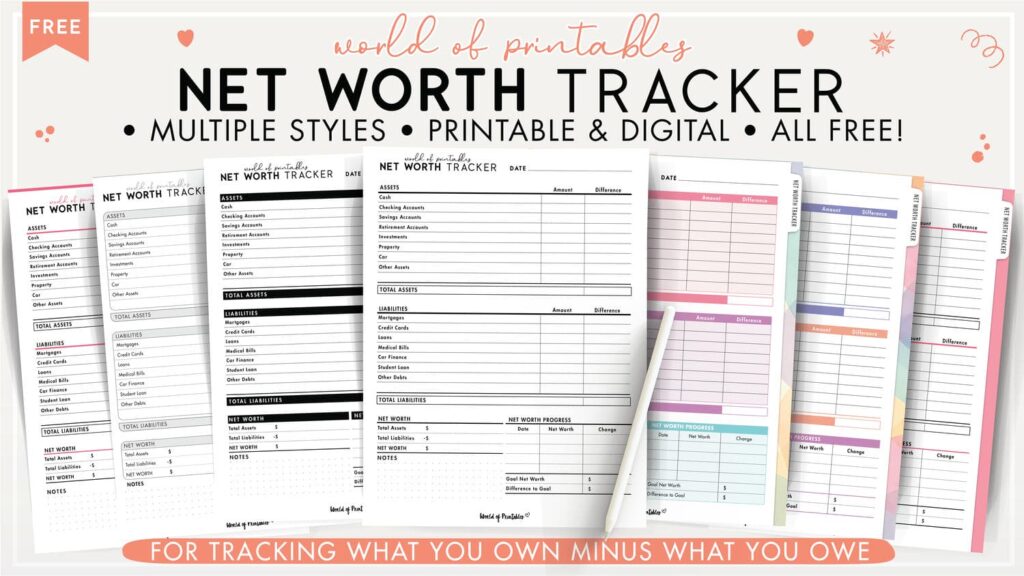
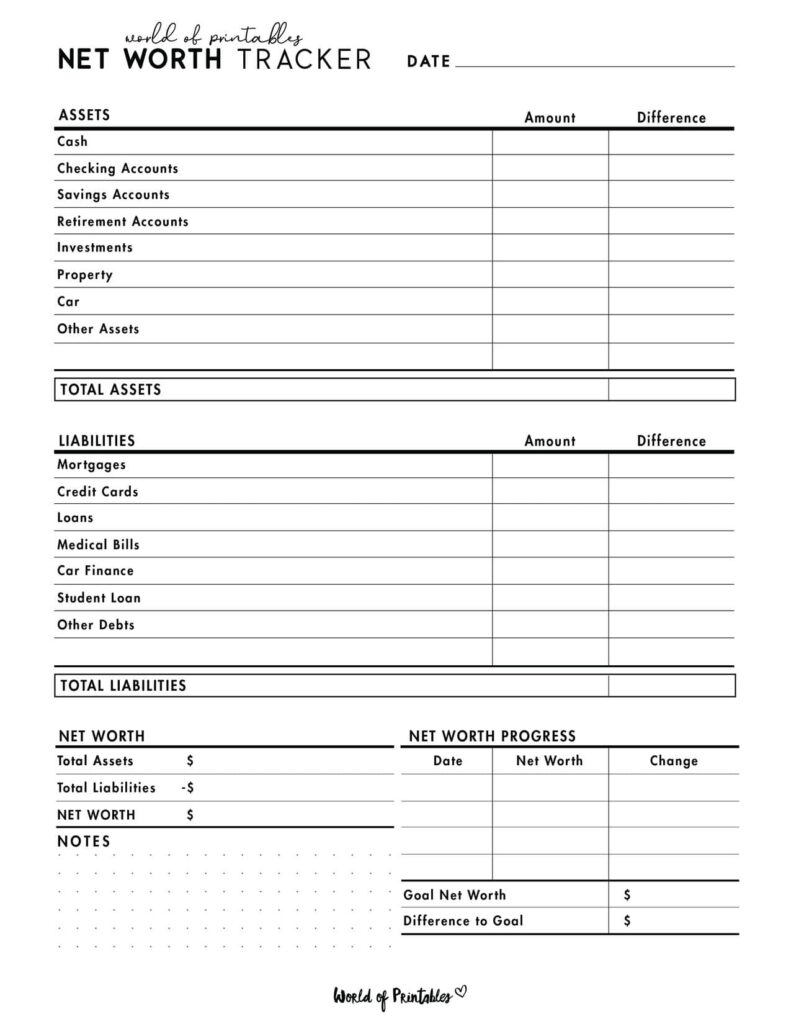
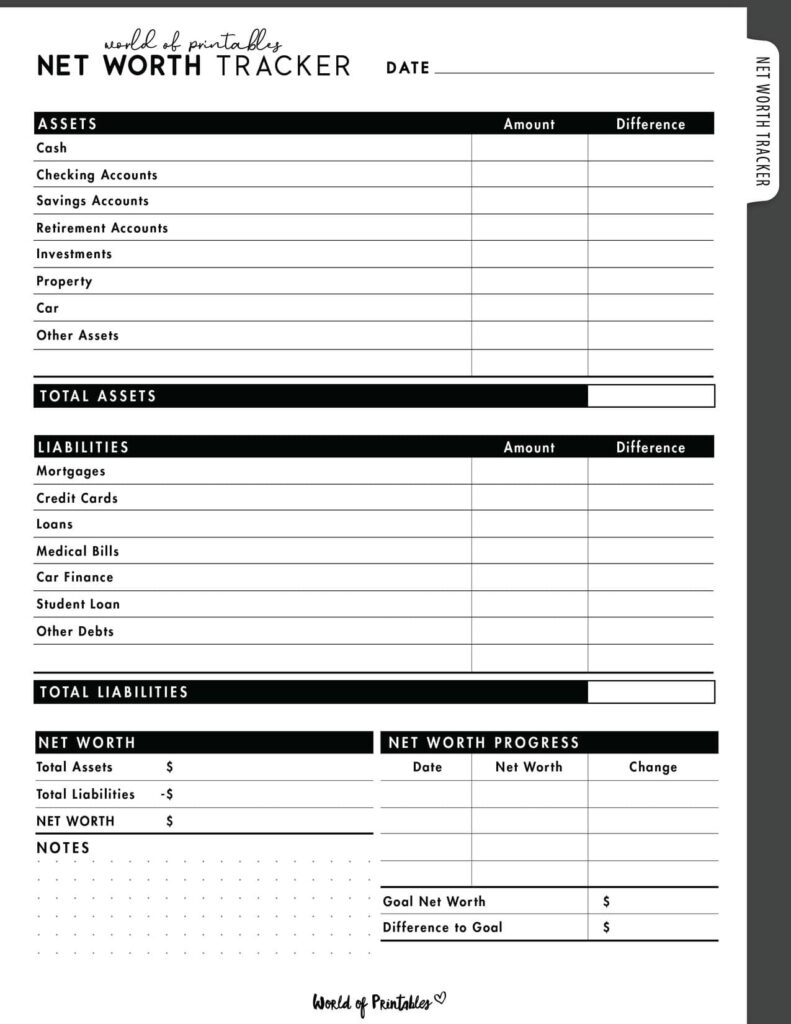
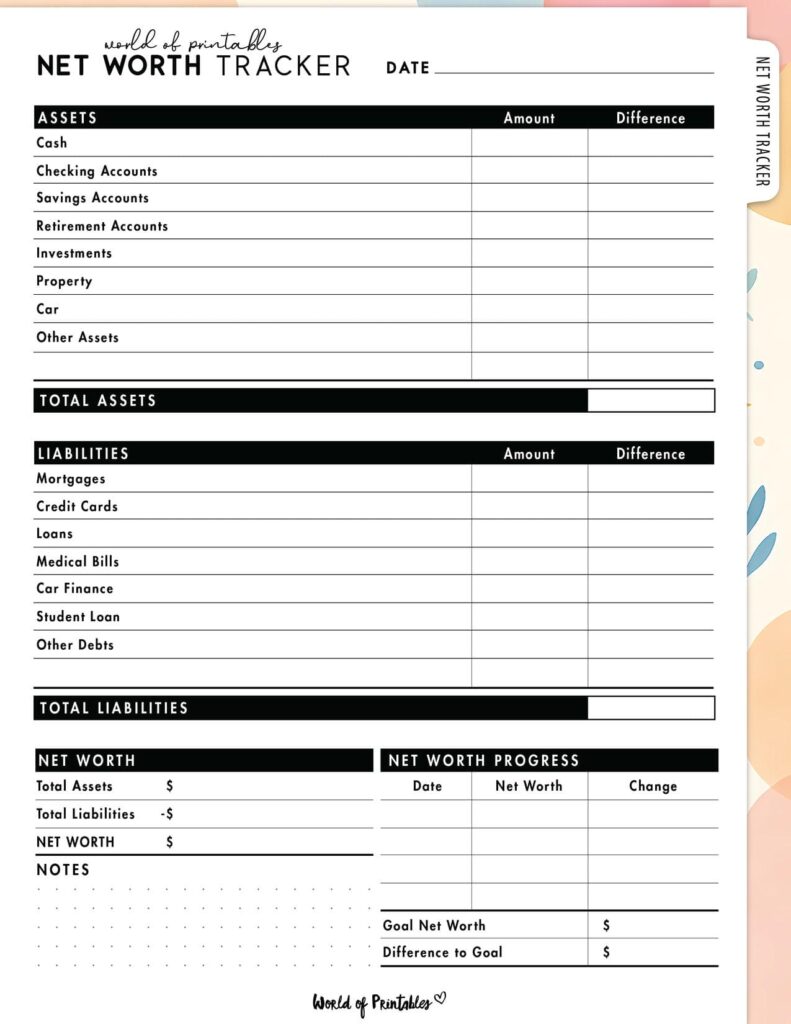
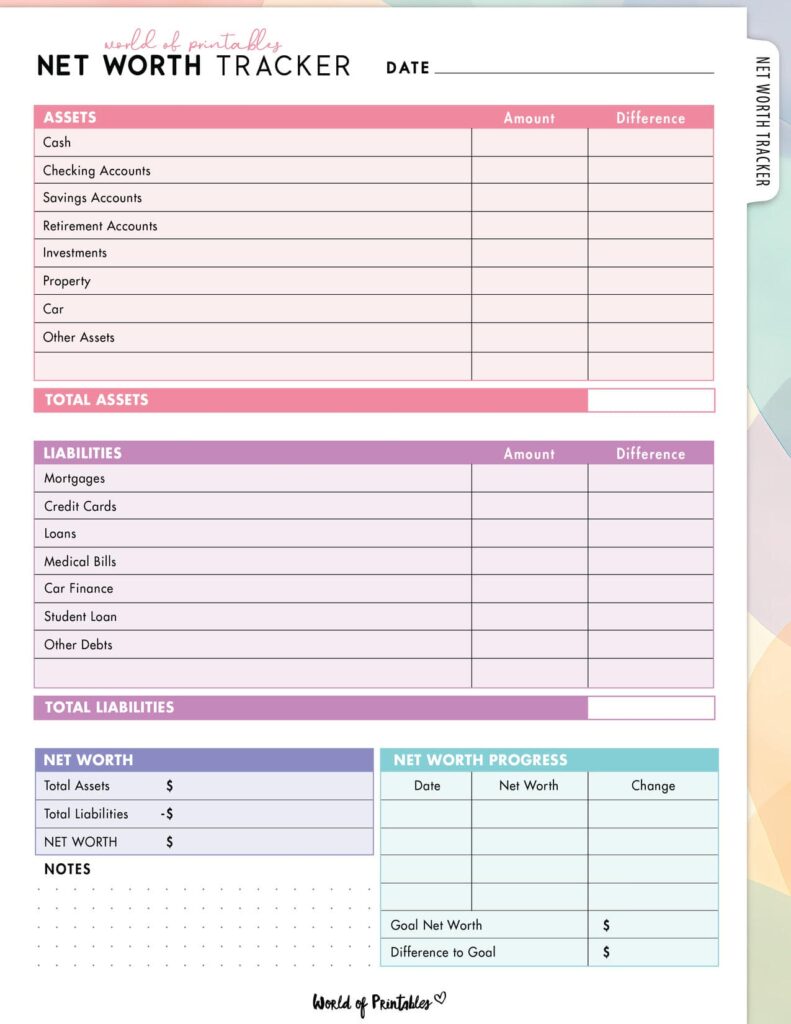
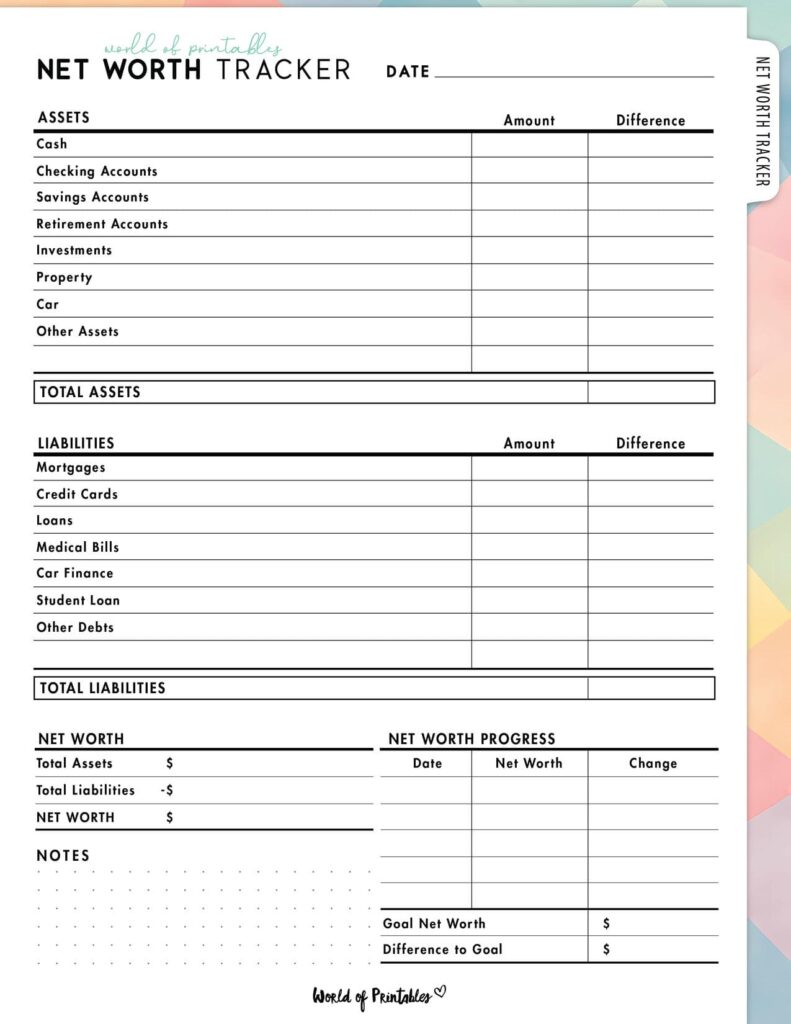
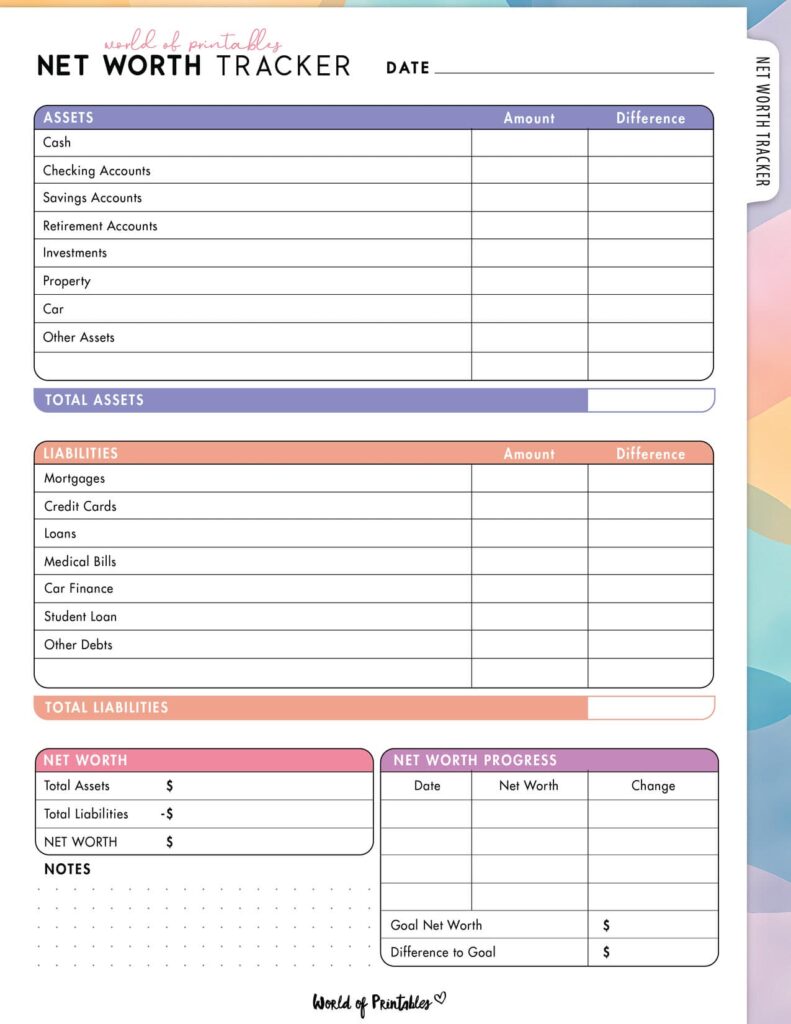
This printable comes in a range of layouts so you can choose the one that suits your binder and planning style best.
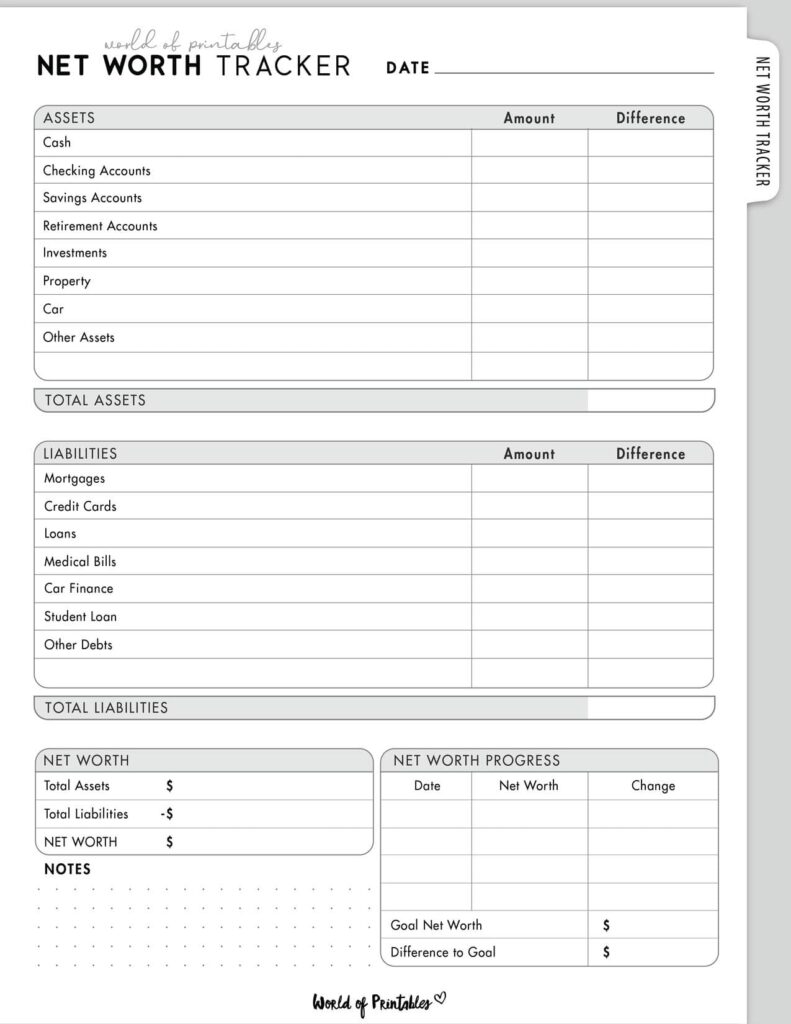
Minimalist and simple styles
These are ideal if you want a clean, structured page that keeps the focus entirely on the numbers.
They work especially well in a more classic budget binder setup.
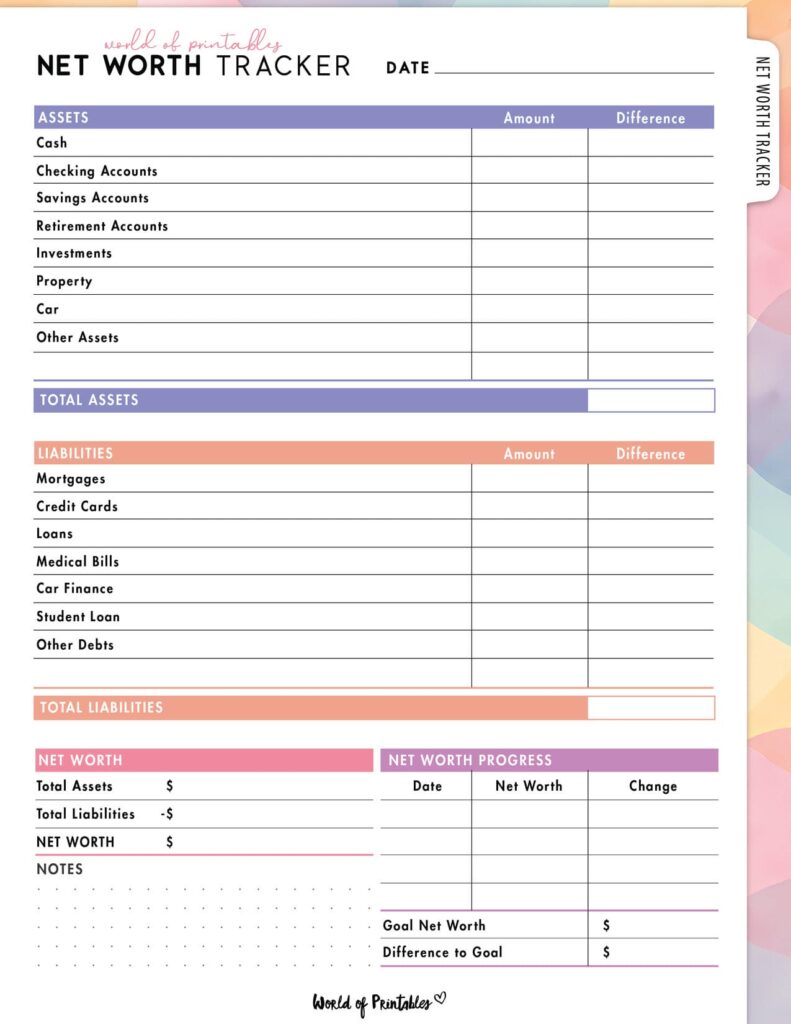
Colorful and visual styles
These are great if you like separating assets and liabilities visually at a glance.
That can make the page easier to scan and a little more satisfying to review each time you update it.
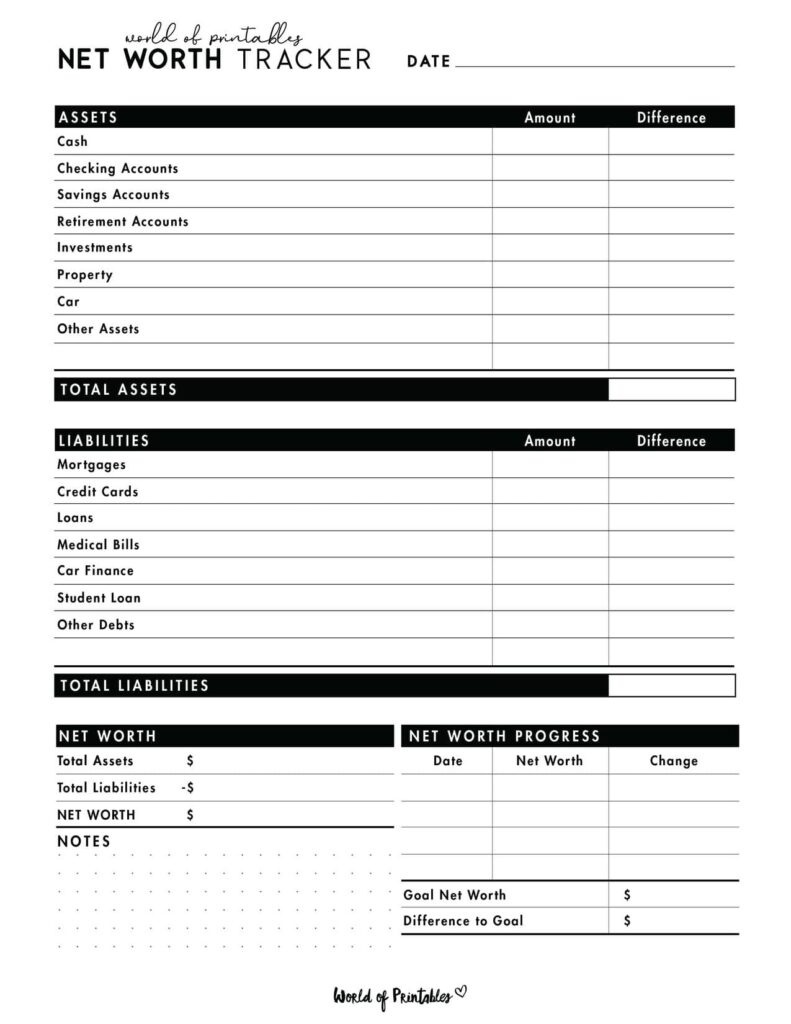
Ink-saving options
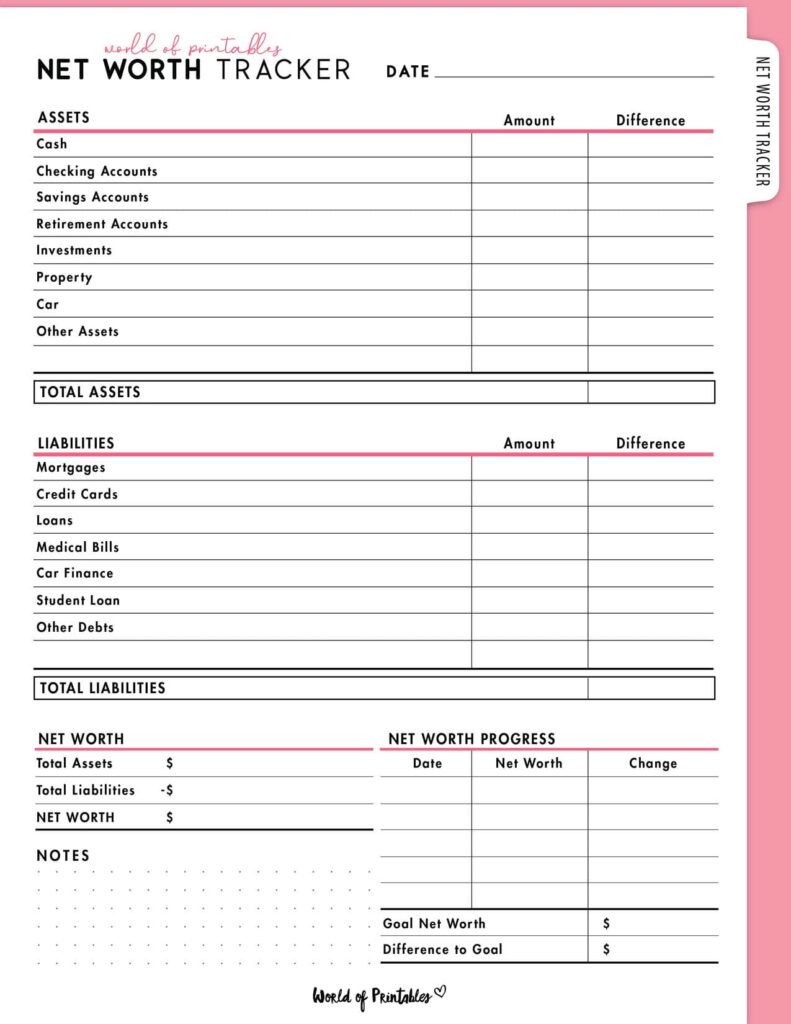
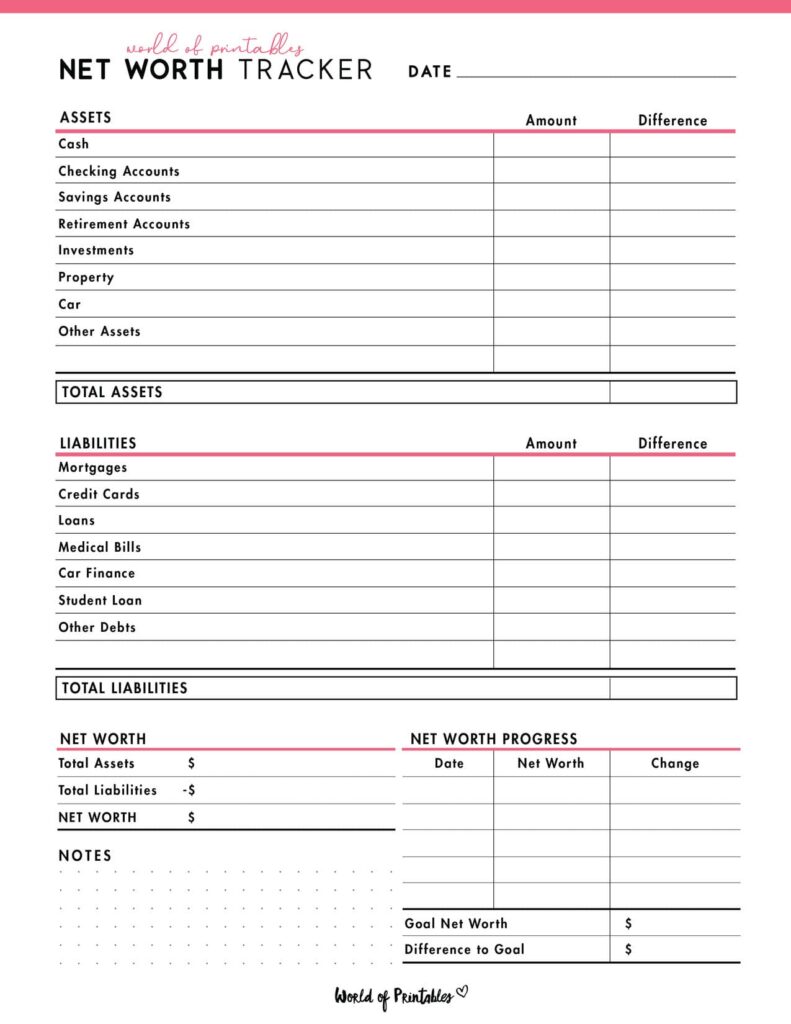
If you prefer practical, low-ink printables, these are a smart option.
They still feel polished and professional while being efficient to print.
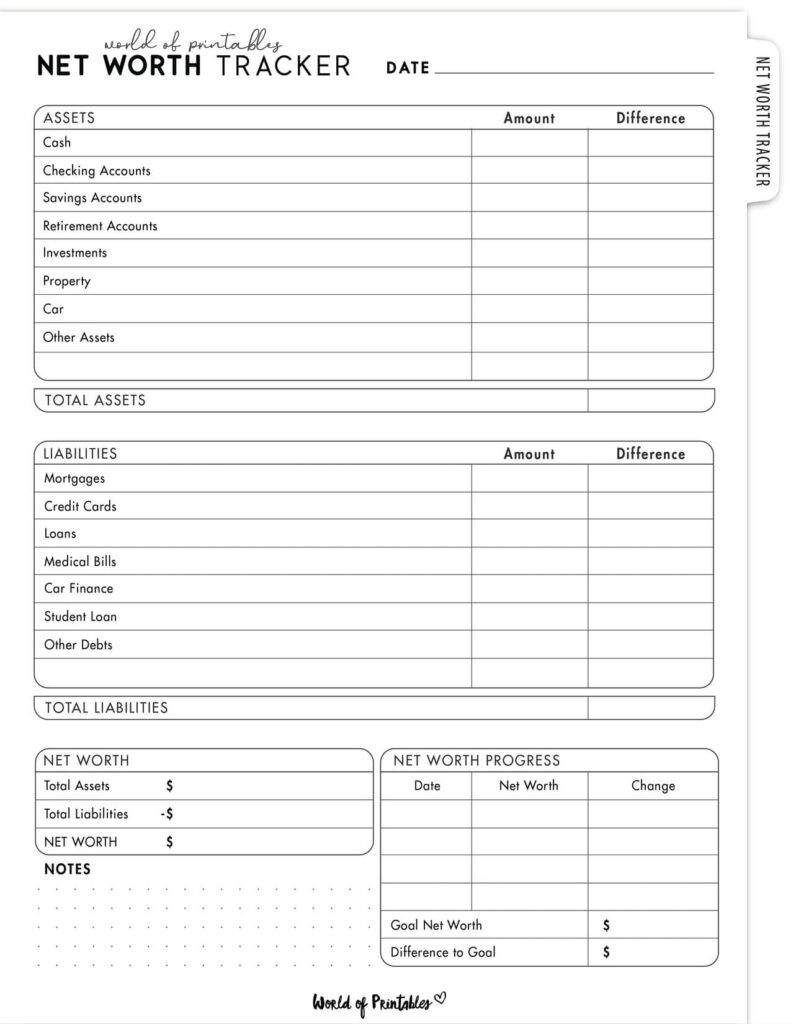
Free Download and Printing Instructions
To download your free Net Worth Tracker, click the text link directly beneath the image of your preferred design. This will open the high-resolution PDF.
For the best printing results:
- download the PDF directly to your device
- open the file and select Print
- make sure your printer is set to US Letter
- choose Fit to Page or Scale to Fit so the margins print correctly
If you want the page to hold up well in your binder over time, it can be worth printing it on slightly thicker paper.
A premium 28 lb or 32 lb paper gives it a more durable, high-quality feel.
How to Use a Net Worth Tracker
This is a fantastic printable! Tracking Net Worth can sound intimidating, but for a typical family, it’s really just a snapshot of “what we own” minus “what we owe.”
This printable is simple to use, but accuracy matters more than speed here.
It is usually best to update it:
- monthly, or
- quarterly
Monthly is helpful if you like close tracking. Quarterly is great if you prefer a more zoomed-out view.
For this example, we’ve used a typical homeowner scenario where it’s used for checking in at the end of the first quarter. We use the “Difference” column to show the change from the previous month.
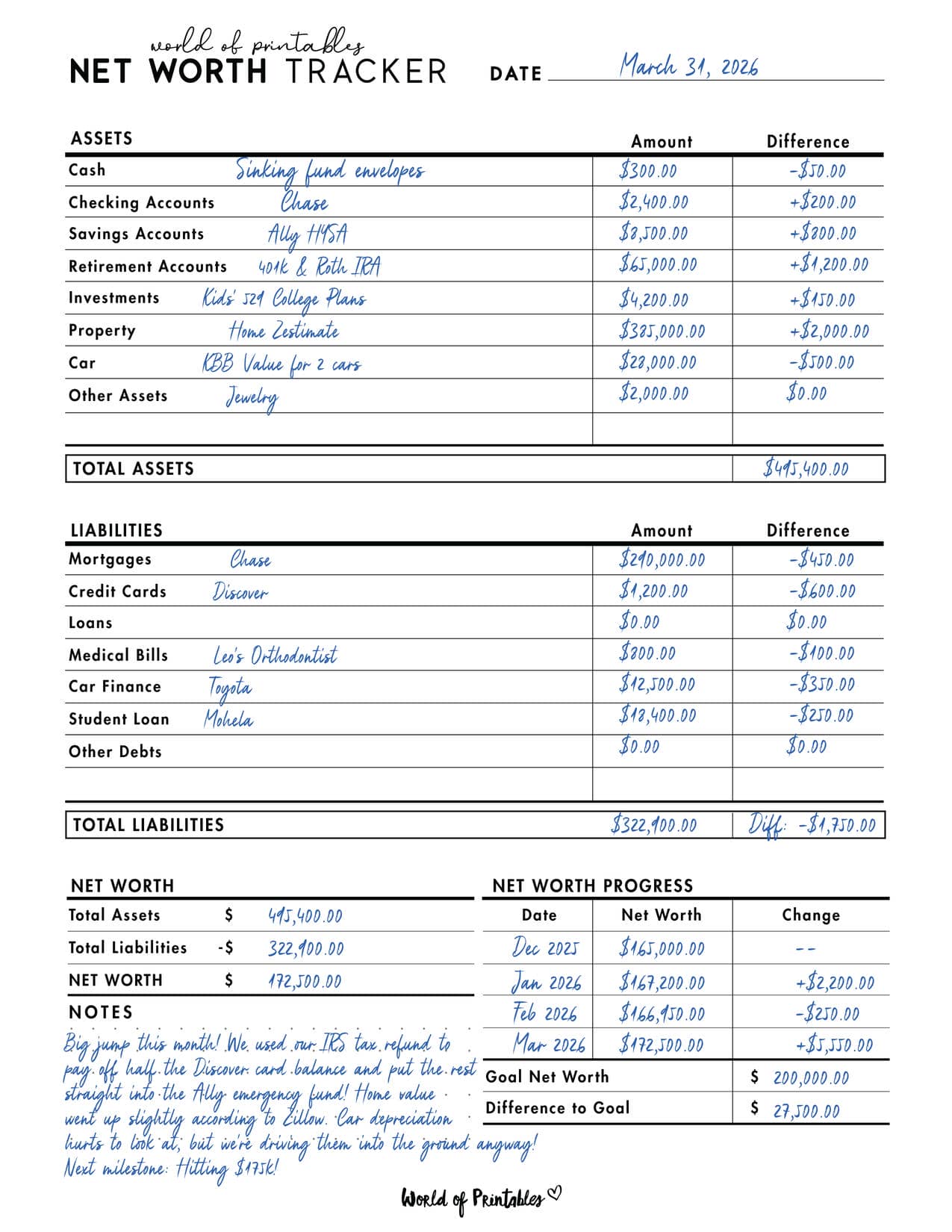
As you can see from the example, it’s highly motivating because even as cars depreciate, paying down the mortgage and student loans makes the net worth go up every single month.
Here is the best way to fill it out:
Step 1: Add up your liquid assets
Start with the money you can access easily.
This might include:
- checking or current accounts
- savings accounts
- emergency fund
- cash savings pots
- high-yield savings accounts
These are usually the easiest figures to gather because they are based on current balances.
Step 2: Add your invested and major assets
Next, record the value of your larger assets.
This may include:
- retirement accounts
- brokerage or investment accounts
- property or home value
- cash value of other accounts
- vehicles, if you choose to include them
- other significant assets
Some of these numbers are easier to estimate than others.
For example, property value is often an estimate, while an account balance is more exact. That is fine. The goal is not perfect valuation every time. The goal is a clear and honest snapshot.
Step 3: List your liabilities
Now write down everything you owe.
This may include:
- mortgage balance
- car finance
- personal loans
- student loans
- credit card balances
- overdrafts
- any other outstanding debt
This is the part people sometimes avoid, but it is essential. A net worth calculation only works when both sides are included honestly.
Step 4: Subtract liabilities from assets
Now total your assets and total your liabilities.
Then subtract:
Total Assets – Total Liabilities = Net Worth
That final number is your current net worth.
If the number is negative, do not panic. That does not mean the tracker failed. It simply means the tracker is showing you your real current position, which is exactly what it is supposed to do.
The real value of this printable is not one number on one day. It is seeing how that number changes over time.
What counts as an asset?
This is one of the most common questions people have.
In general, assets are things that have real value and belong to you.
Common examples include:
- cash in the bank
- savings
- investments
- retirement accounts
- property value
- vehicles, if included
- valuable business cash or accounts, if relevant
Some people keep their tracker very simple and only include major assets. Others make it more detailed. Both approaches can work, as long as you stay consistent.
What counts as a liability?
Liabilities are money you owe.
Common examples include:
- mortgage balance
- credit cards
- loans
- finance agreements
- overdrafts
- other debt balances
If you are unsure whether to include something, a good rule is this:
If it is money you are responsible for paying back, it belongs on the liabilities side.
Why consistency matters more than perfection
A net worth tracker does not need to be perfect to be useful.
It just needs to be consistent.
If you include:
- property
- retirement accounts
- savings
- debts
then keep including those categories each time.
That consistency is what lets you compare one update to the next and see whether you are moving in the right direction.
The goal is not a flawless financial report. It is a reliable snapshot you can build on.
Why this page can be surprisingly motivating
This printable is especially encouraging because it shows progress that a normal budget often does not.
For example:
- your savings might be growing
- your credit card debt might be shrinking
- your mortgage balance might be lower
- your investment account might be gradually increasing
When all of that is written down together, progress becomes much easier to see.
That can be incredibly motivating, especially during slower financial seasons when it feels like your efforts are not adding up.
Who this printable is especially helpful for
This page is a great fit if you:
- want a bigger-picture view of your finances
- are paying down debt and want to see real overall progress
- are building savings and investments
- like tracking long-term financial improvement
- are creating a budget binder with both planning and review pages
- want a more complete way to measure financial health than income alone
It is especially helpful if you want to stop measuring success by how much you earn and start measuring it by how much your financial position is improving.
What to include on your Net Worth Tracker
A useful net worth page should feel clear and not overly busy.
Helpful sections include:
- date
- liquid assets
- savings
- investment accounts
- property and large assets
- total assets
- mortgages and loans
- credit card balances
- total liabilities
- final net worth
Some people also like to add:
- a small notes section
- a change from last month or last quarter
- a graph or trend line if they update regularly
A good question to ask after each update
After calculating your net worth, ask yourself:
What moved the number most this time?
Was it:
- debt reduction
- savings growth
- investment growth
- a property change
- extra spending that slowed progress
That question helps turn the page into more than just a number. It helps you understand what is actually shaping your financial progress.
Next Step: Build Your Complete Financial Command Binder
A Net Worth Tracker helps you see your overall financial position clearly, but it works even better when it is supported by the right planning pages.
Helpful pages to add next include:
- a monthly budget planner
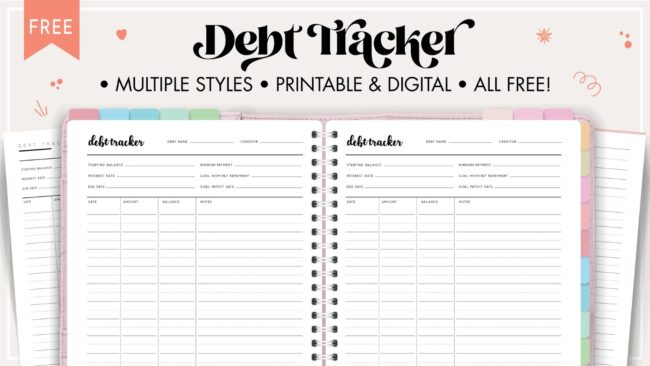
- a debt payoff tracker
- an annual financial goals worksheet
- a year-end financial summary
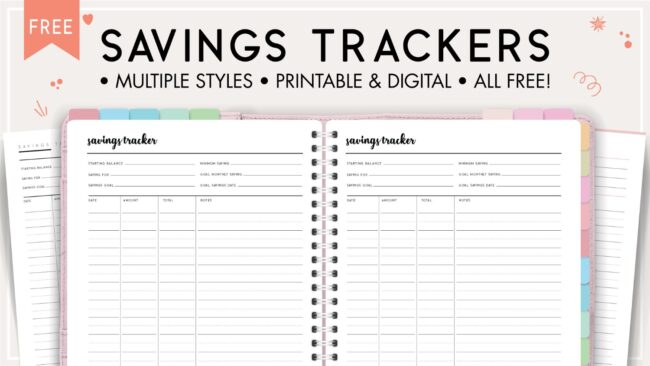
- a savings tracker
Together, these pages help you not only measure your financial progress, but also create the habits and systems that keep moving that number in the right direction.
Keep building your system by downloading the next essential tools in the binder:
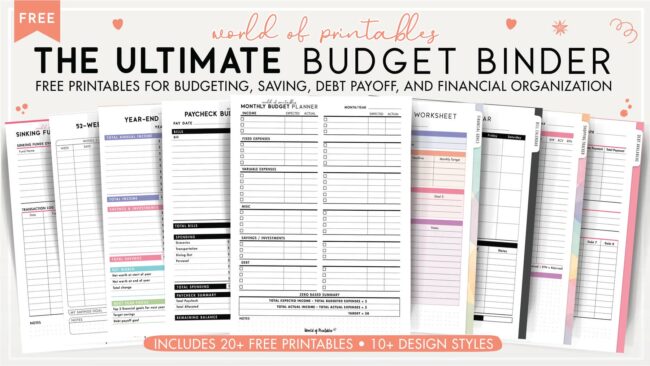
- Return to the Printable Budget Binder bundle Index.
- Download the Monthly Budget Planner (Zero-Based) to assign every dollar a job.
- Download the Debt Snowball Tracker to start aggressively crushing your liabilities.
More budgeting templates
You’ll find many more budgeting templates right here on World of Printables.


AI TRANSPARENCY: Whilst the majority of our creations have been created completely traditionally, occasionally we utilize AI tools in our design process. We acknowledge the advancements in AI technology and leverage them responsibly to optimize our creative output. However, it is important to note that our utilization of AI does not compromise the human element of our work. Our commitment to delivering high-quality designs through a balanced integration of traditional expertise and AI enhancements remains paramount.