

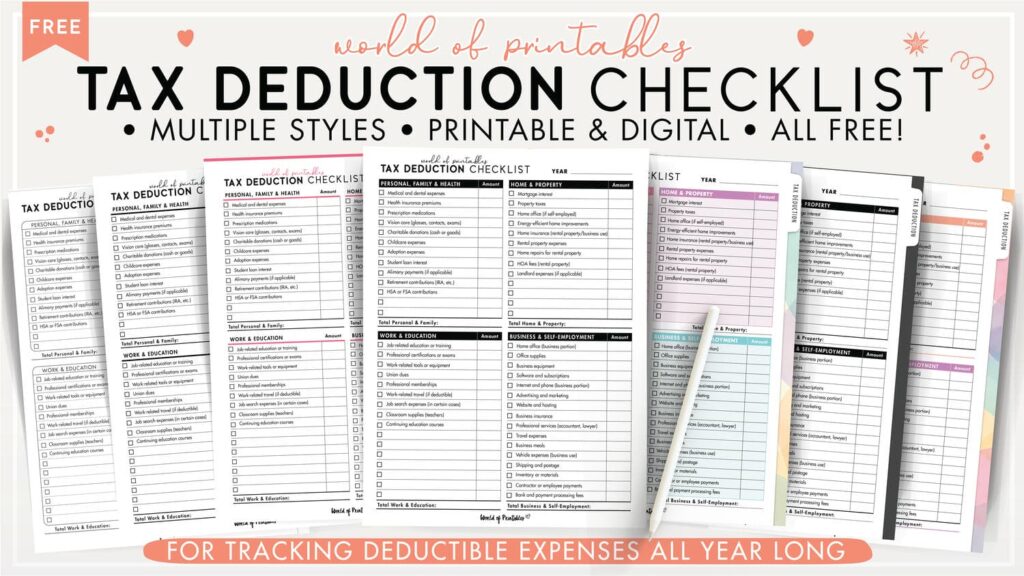
Disclaimer: We provide high-quality, free printable templates to help you organize your personal data. We are not certified financial planners, CPAs, or investment advisors. The tools and information provided below are for educational and organizational purposes only. Always consult a licensed tax professional or CPA before making high-stakes decisions regarding itemized deductions, tax strategy, or IRS compliance.
Tax season gets a lot more stressful when you are trying to remember everything at once.
You know you had medical costs. You know you made donations. You know there were business expenses, receipts, maybe a few forms that arrived in the post and got put “somewhere safe.” But when it is finally time to pull everything together, it can all feel surprisingly messy.
That is exactly why a Tax Deduction Checklist can be so helpful.
This printable gives you one place to keep track of the deduction categories and documents you may need, so you can stay more organized throughout the year and feel far less overwhelmed when tax season arrives.
It is not about making taxes complicated. It is about making the process clearer, more manageable, and much easier to prepare for.
If you keep a budget binder, this is one of the most useful pages to add near the front.
What is a Tax Deduction Checklist?
A Tax Deduction Checklist is a printable designed to help you keep track of common deduction categories, tax-related documents, and the paperwork you may want to gather throughout the year.
Instead of waiting until tax season and trying to remember what applies to you, this page gives you a clear list you can refer to as the year goes on.
It can help you keep track of things like:
- tax forms that arrive in the post or electronically
- medical expenses
- charitable donations
- education-related costs
- home-related deductions
- side hustle or self-employment expenses
- other records you may need to review with a tax professional
It is a preparation and organization tool, which is exactly what makes it so useful.
Why this printable matters
A lot of tax stress comes from disorganization, not just from the forms themselves.
When paperwork is scattered and expenses are not tracked as they happen, tax season turns into a search mission. You end up digging through drawers, checking emails, reprinting statements, and hoping you did not miss anything important.
A Tax Deduction Checklist helps stop that cycle.
It gives you a way to:
- know what to watch for during the year
- gather important records as they come in
- keep tax-related paperwork together
- feel more prepared when it is time to file
- make handoff to a tax professional much easier if you use one
Even if your taxes are fairly straightforward, a checklist makes the whole process feel more under control.
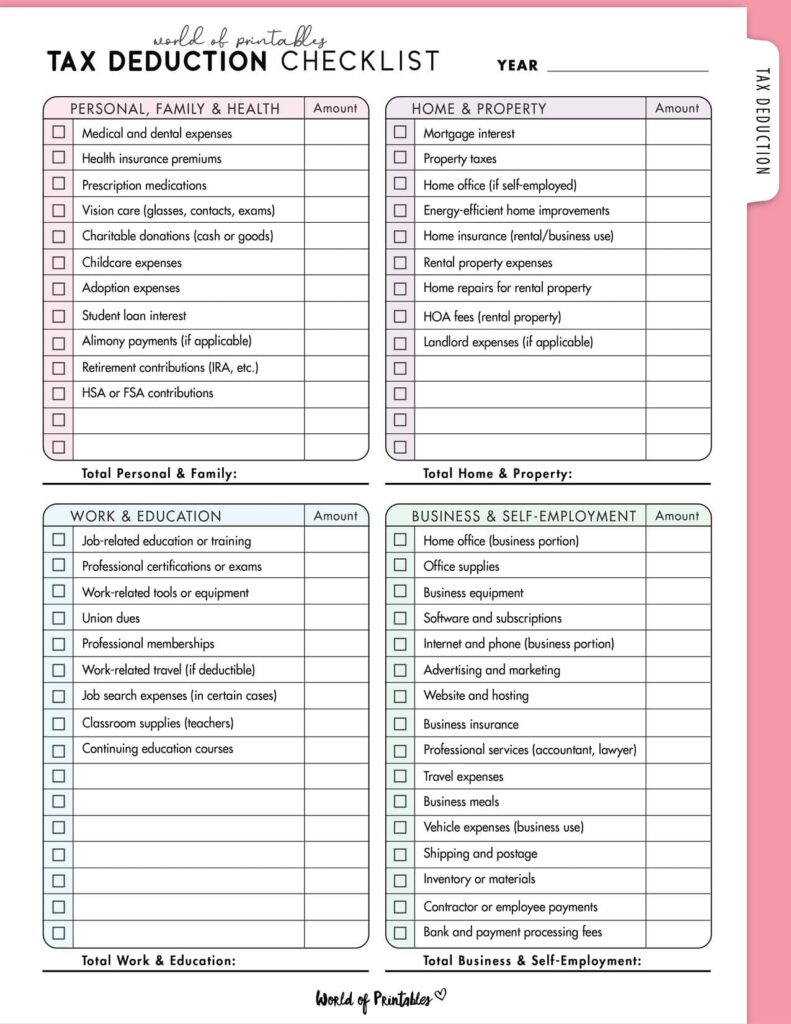
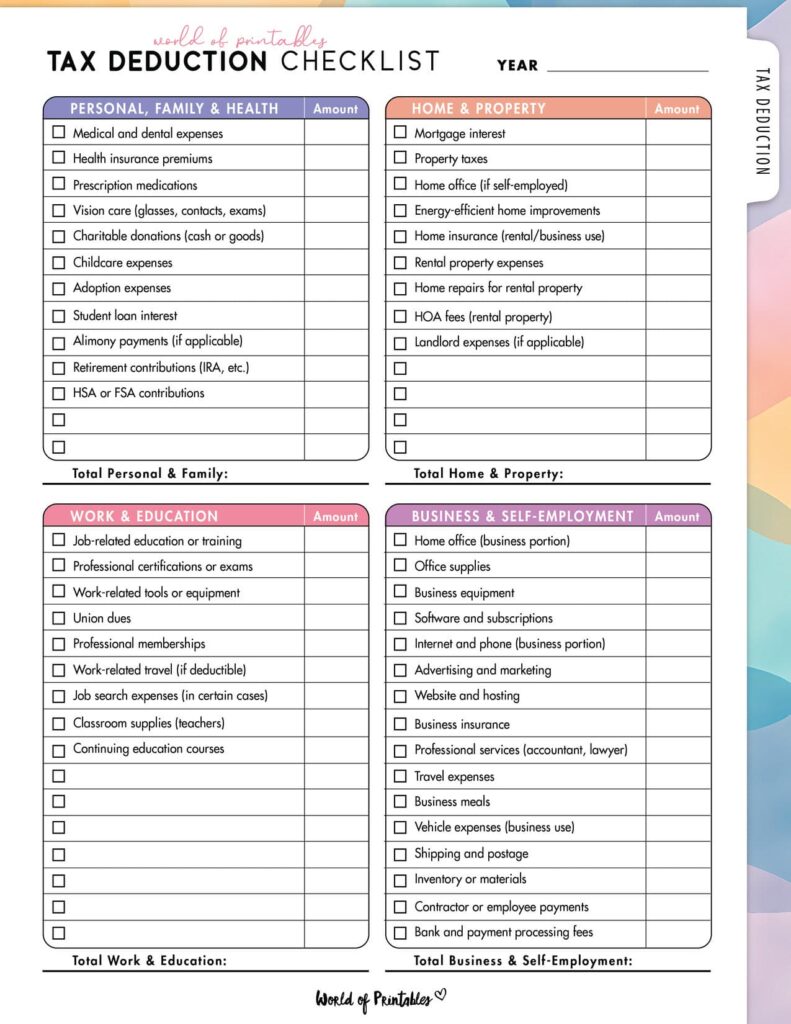
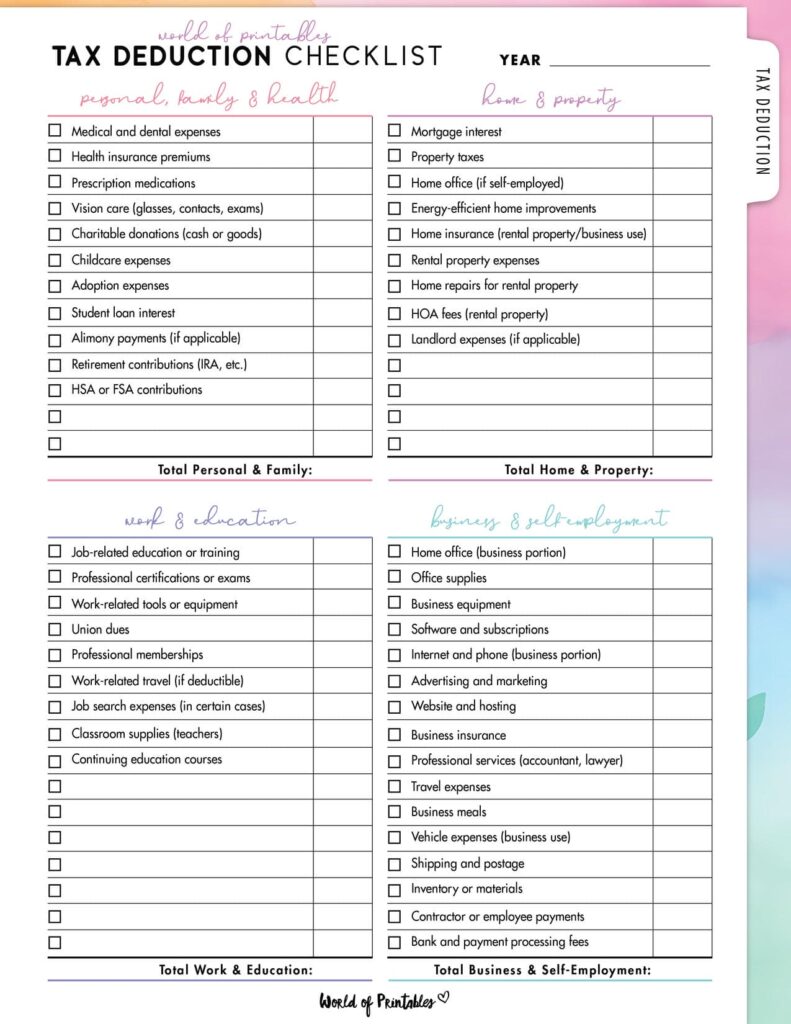
Choose a design theme that fits your style
This printable comes in a range of layouts so you can choose the one that works best for your binder and planning preferences.
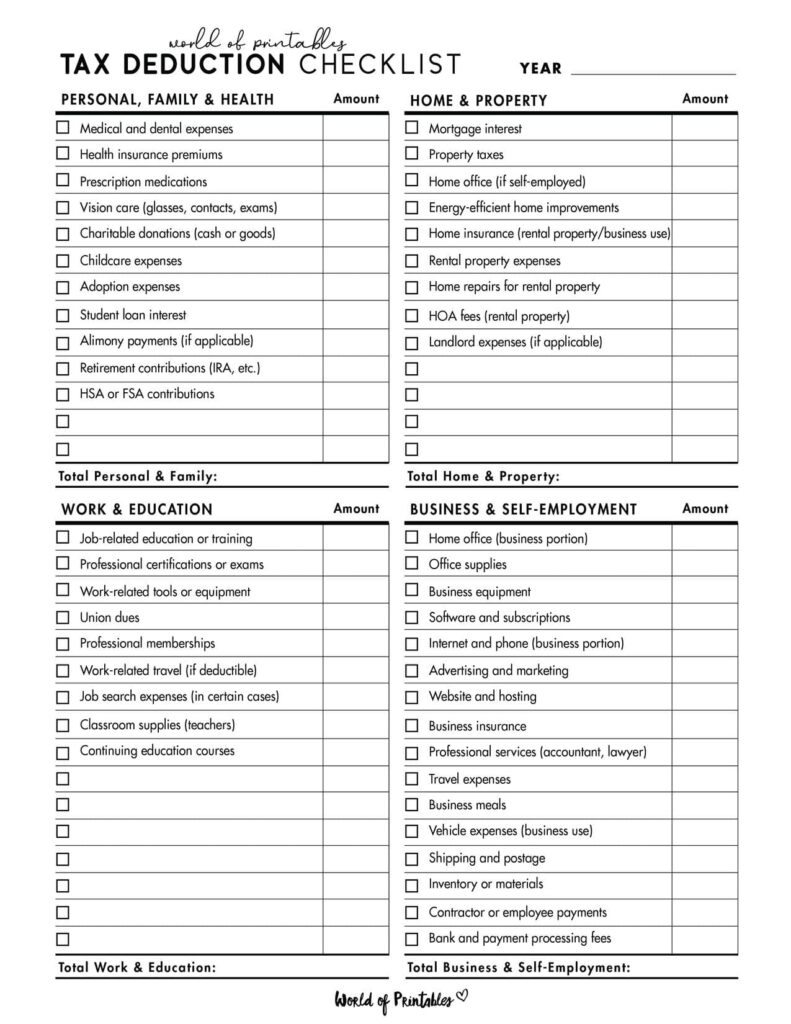
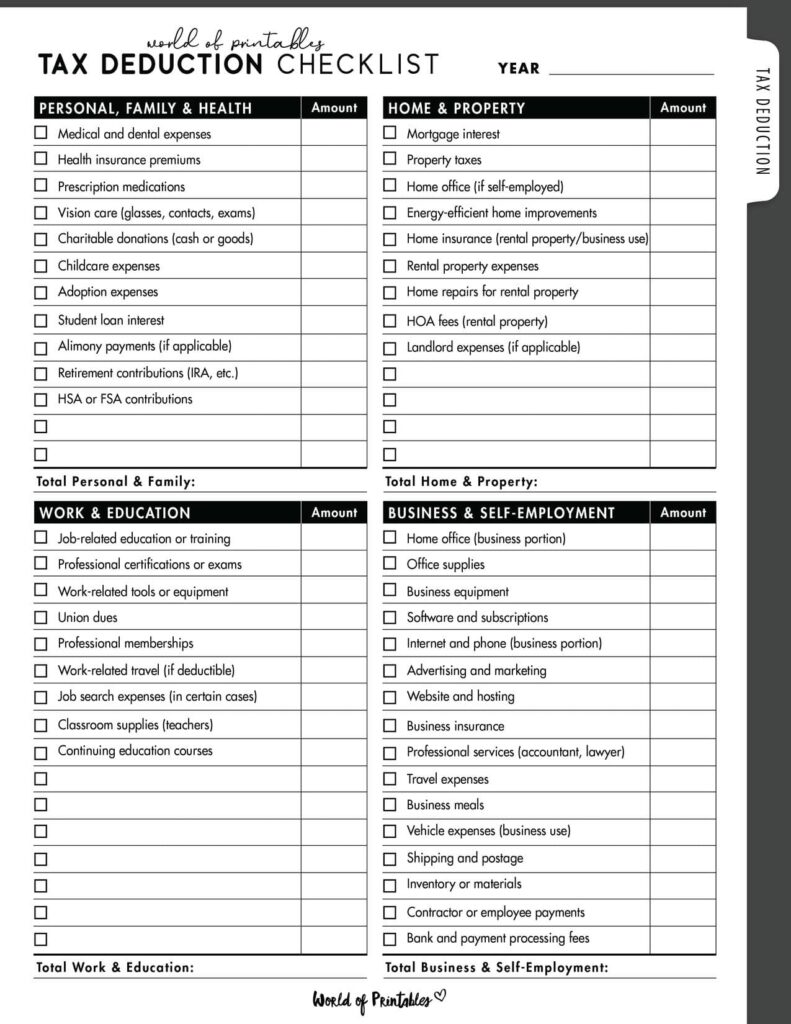
Minimalist and simple styles
These are ideal if you want a clean, professional looking checklist that keeps the focus on clarity and organisation.
They work especially well if you like your finance printables to feel structured and tidy.
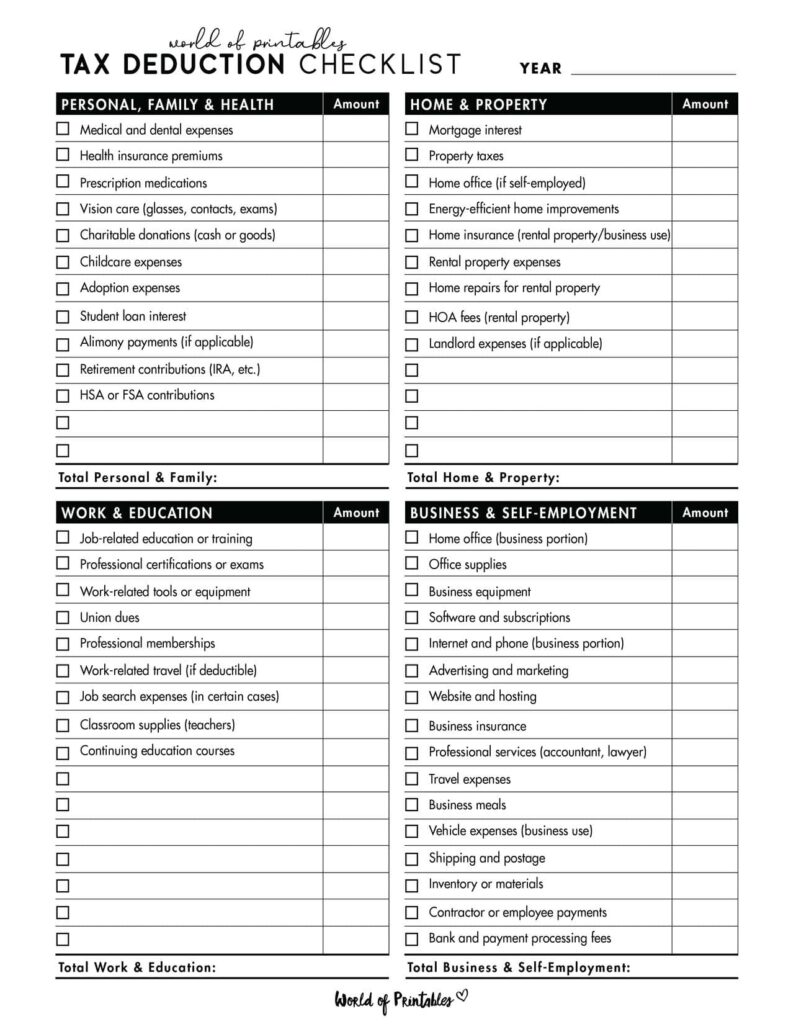
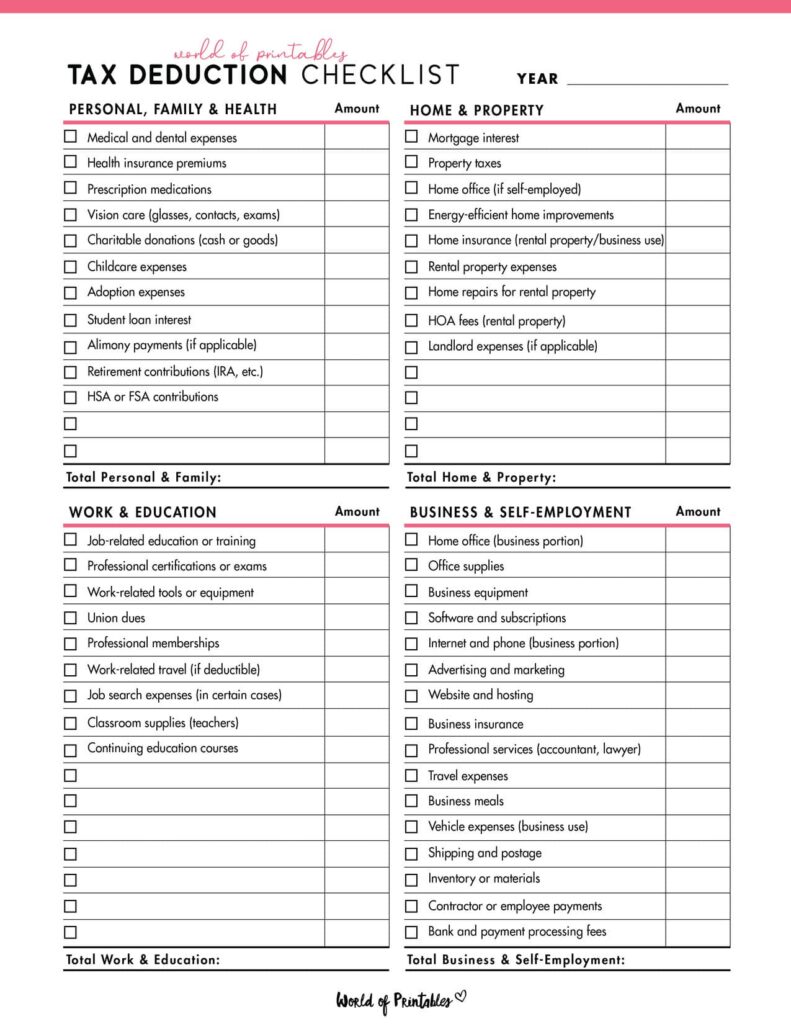
Colorful and visual styles
These are great if you like visual separation between categories.
They can make it easier to quickly distinguish between personal, household, and business-related sections.
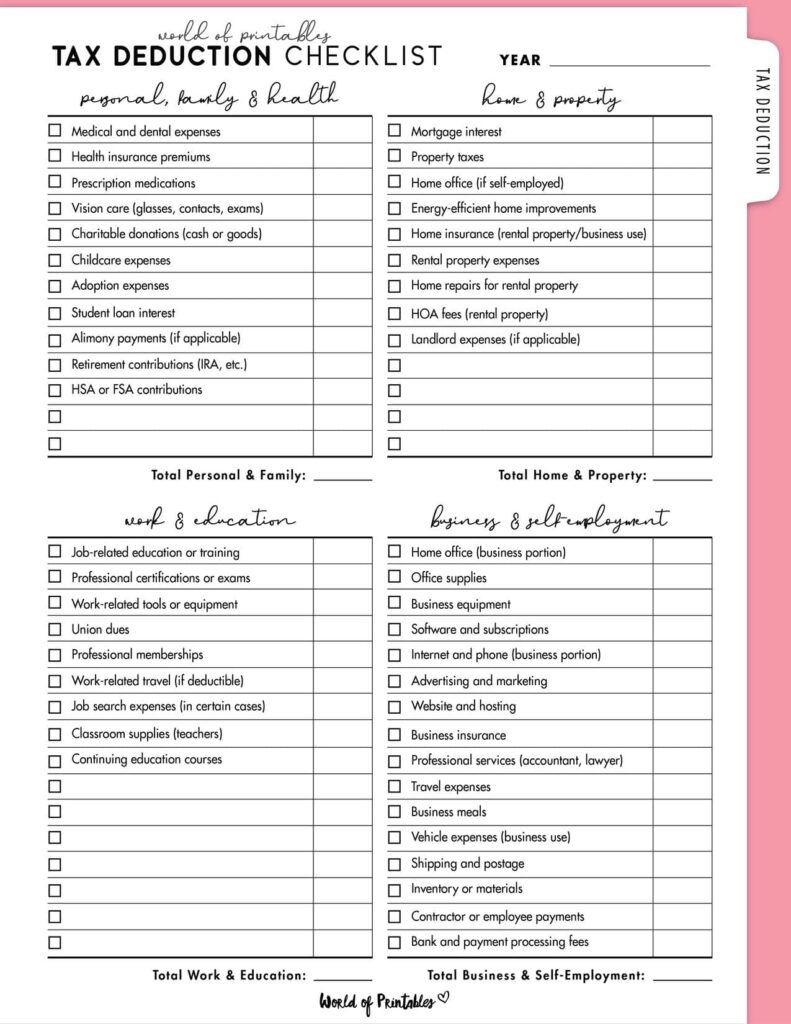
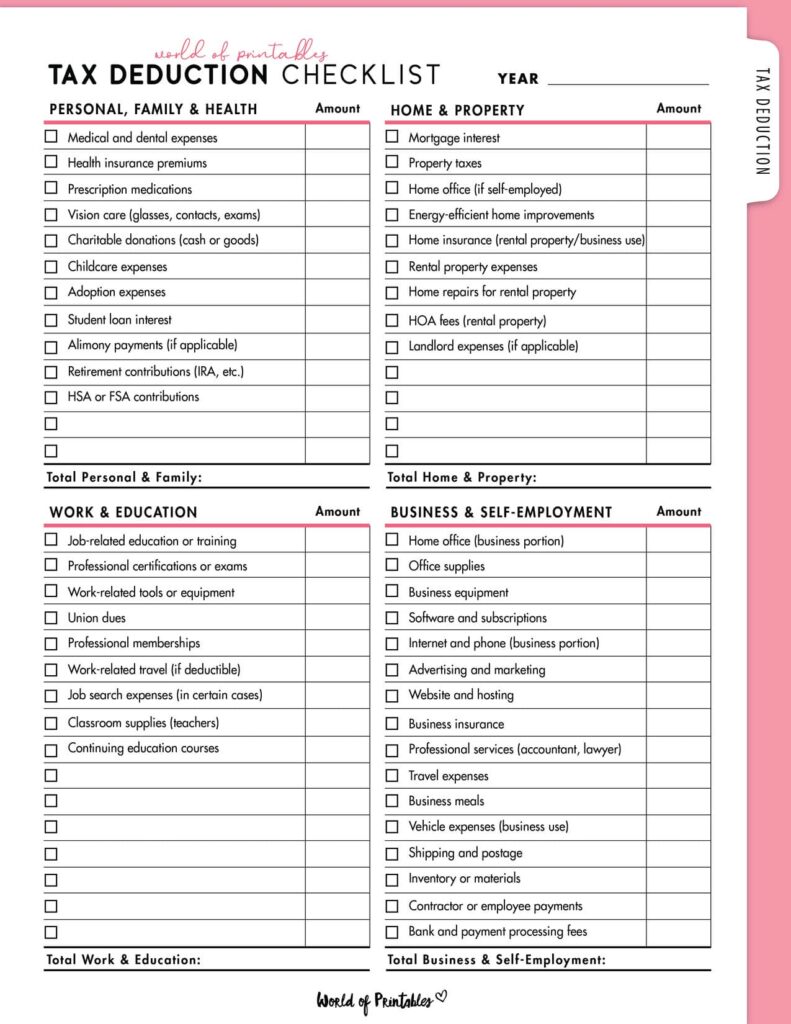
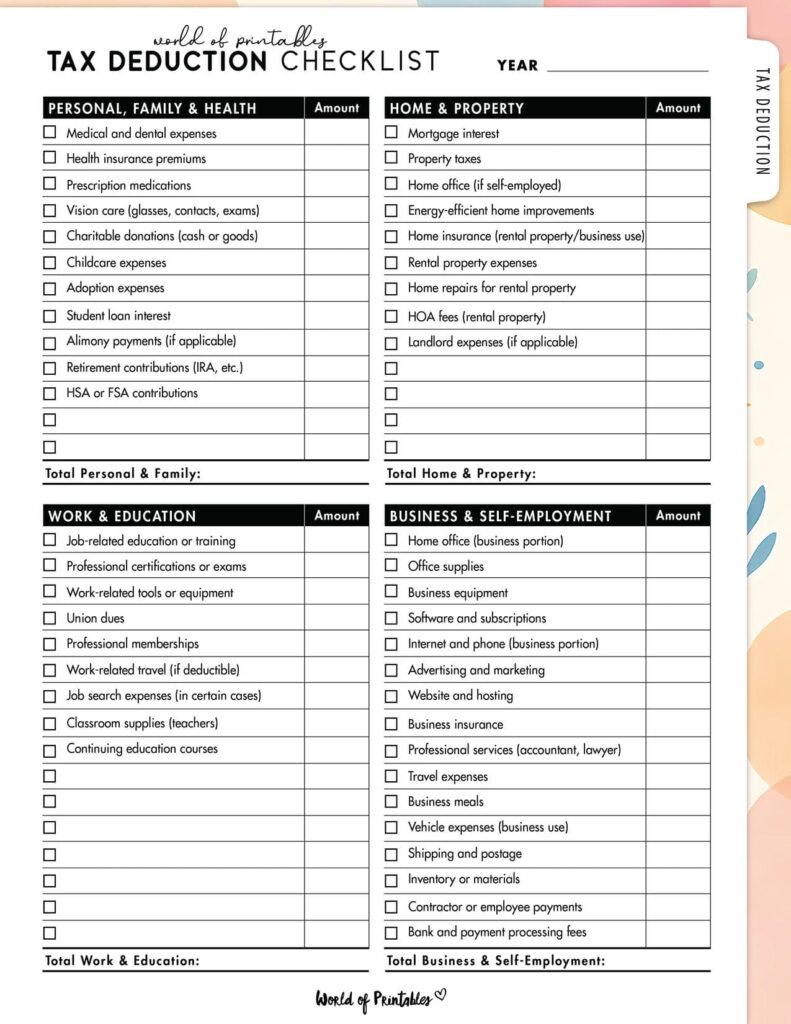
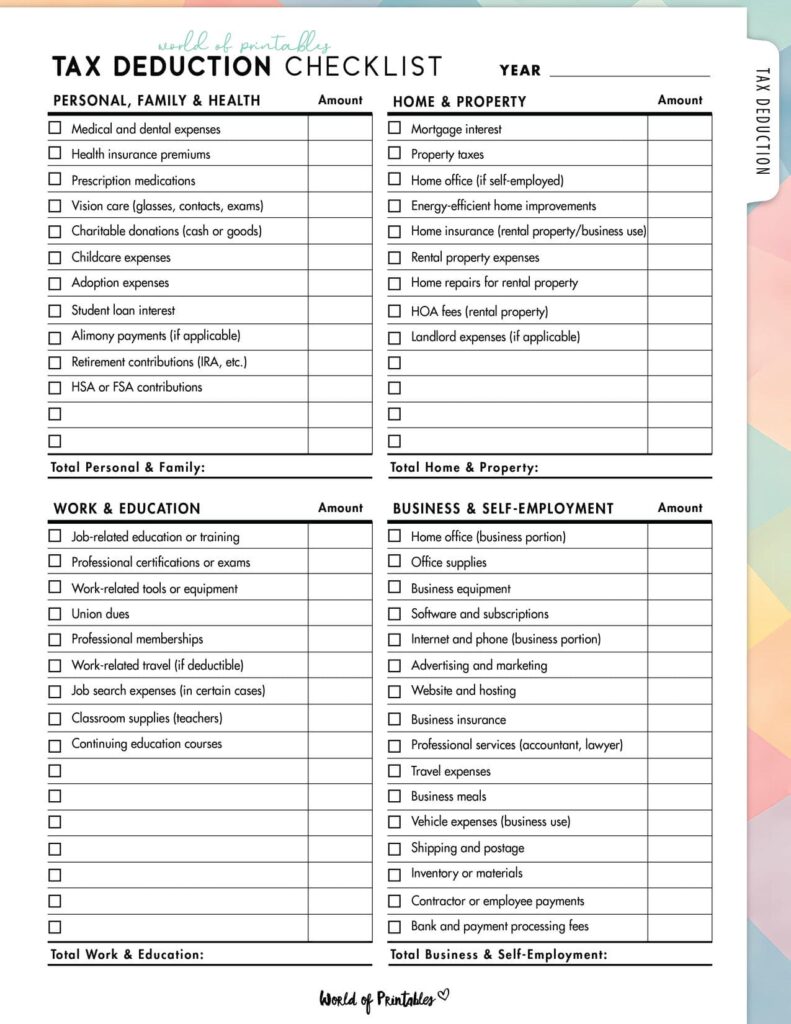
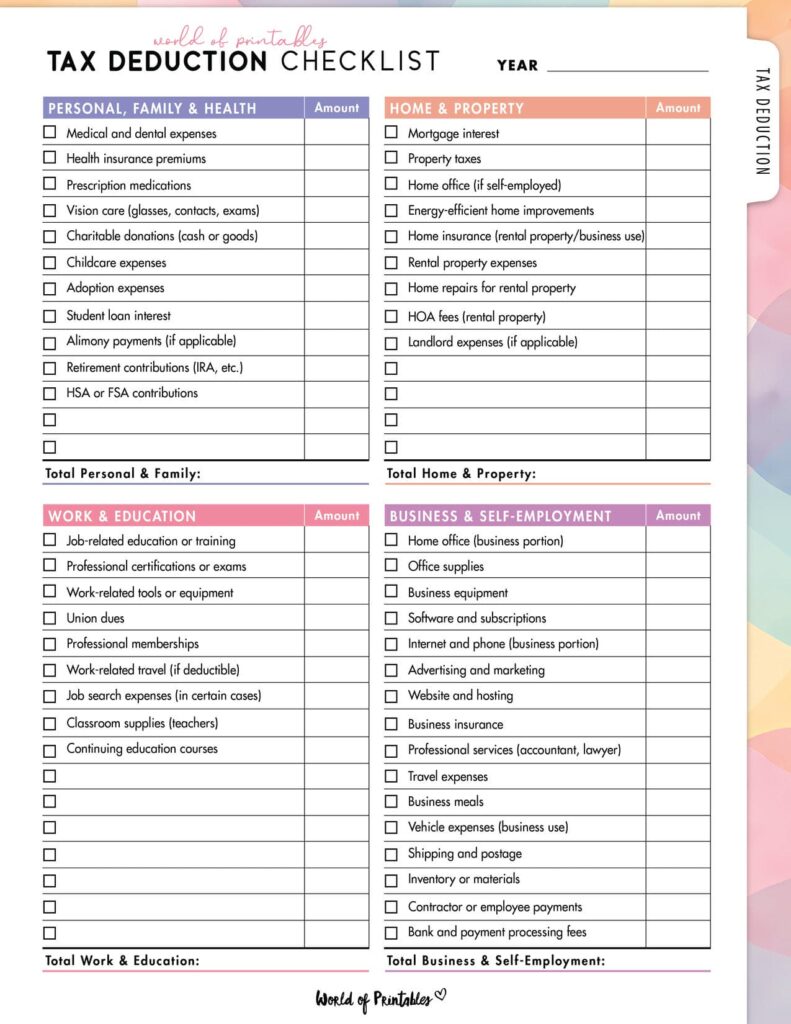
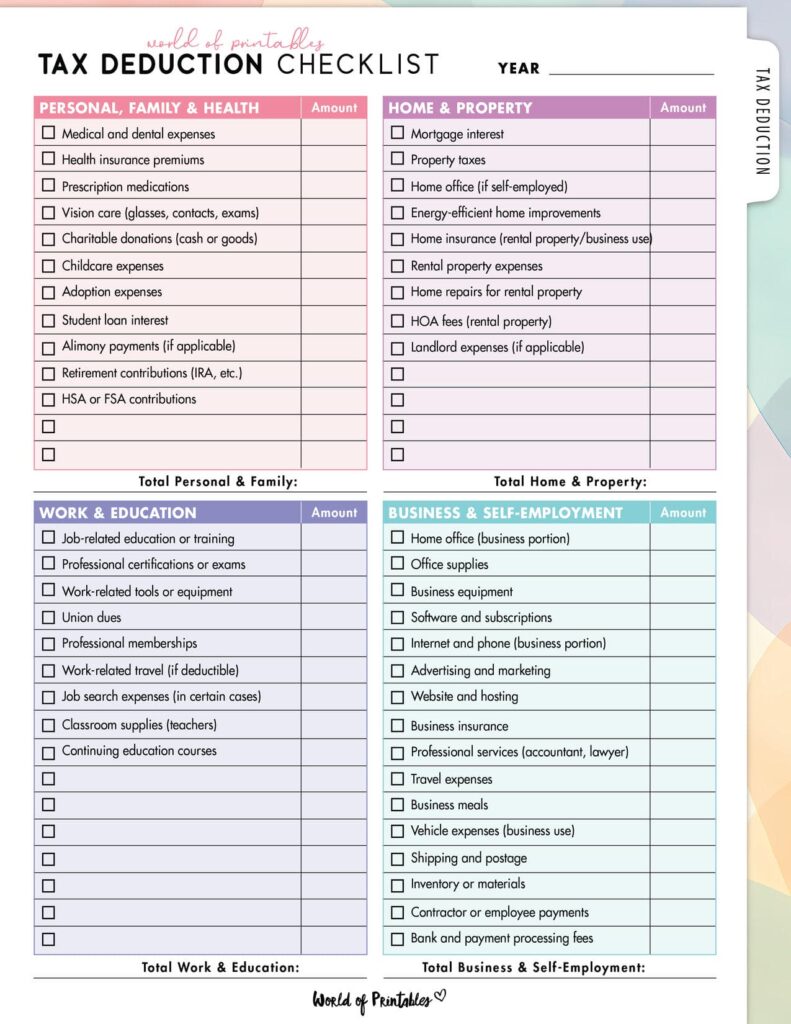
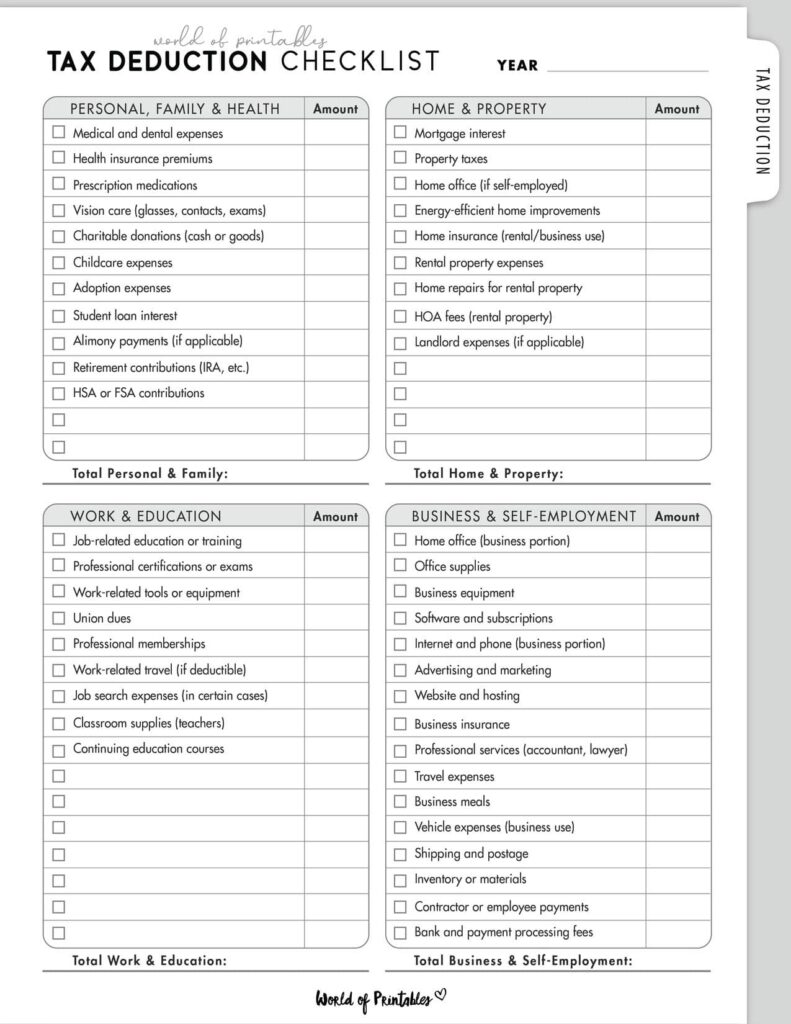
Ink-saving options
If you prefer practical low-ink printables, these are a smart option.
They still feel polished and useful while being efficient to print as part of a larger budget binder.
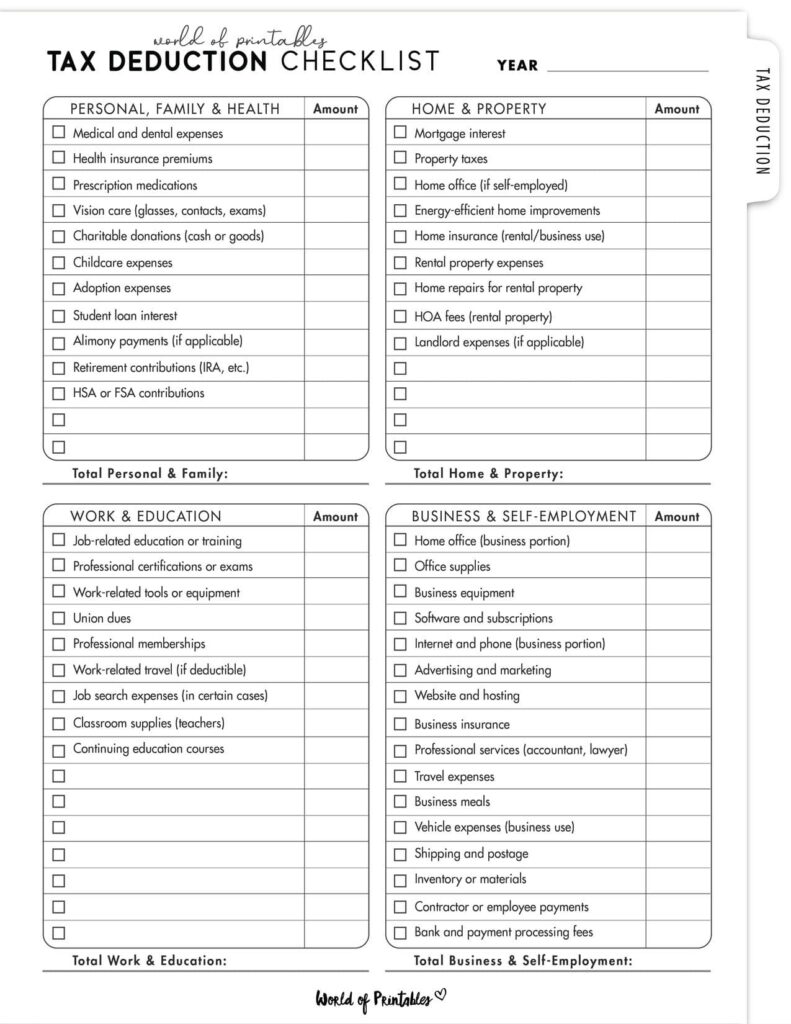
Free Download and Printing Instructions
To download your free Tax Deduction Checklist, click the text link directly beneath the image of your preferred design. This will open the high-resolution PDF.
For the best printing results:
- download the PDF directly to your device
- open the file and select Print
- make sure your printer is set to US Letter
- choose Fit to Page or Scale to Fit so the margins print correctly
If you want this page to hold up well in a binder throughout the year, it can be worth printing it on a slightly thicker paper.
A premium 28 lb or 32 lb paper gives it a durable, high-quality feel.
Why this works best as a year-round page
This is one of those printables that is most useful when you do not leave it until tax season.
The best way to use a Tax Deduction Checklist is to keep it accessible all year long.
That way, when you get a tax form, make a donation, pay for a qualifying expense, or buy something for your side hustle, you already have a place to note it.
By the time tax season arrives, you are not starting from scratch. You are reviewing and completing a system that has been quietly supporting you all year.
How to Use a Tax Deduction Checklist
This is a massive lifesaver for tax season! Getting all these documents together in one place before handing them off to a CPA (or tackling TurboTax) is a huge stress-reliever for families.
For a realistic US household, it’s very common to have a mix of standard family deductions (like child care and student loan interest), homeowner deductions, and a little bit of side-hustle or freelance income (which is why that “Business & Self-Employment” section is perfect).
This printable works best when paired with a simple folder, envelope, or binder pocket for your paperwork.
Here is a highly relatable, comprehensive example for a family tracking their expenses for the tax year:
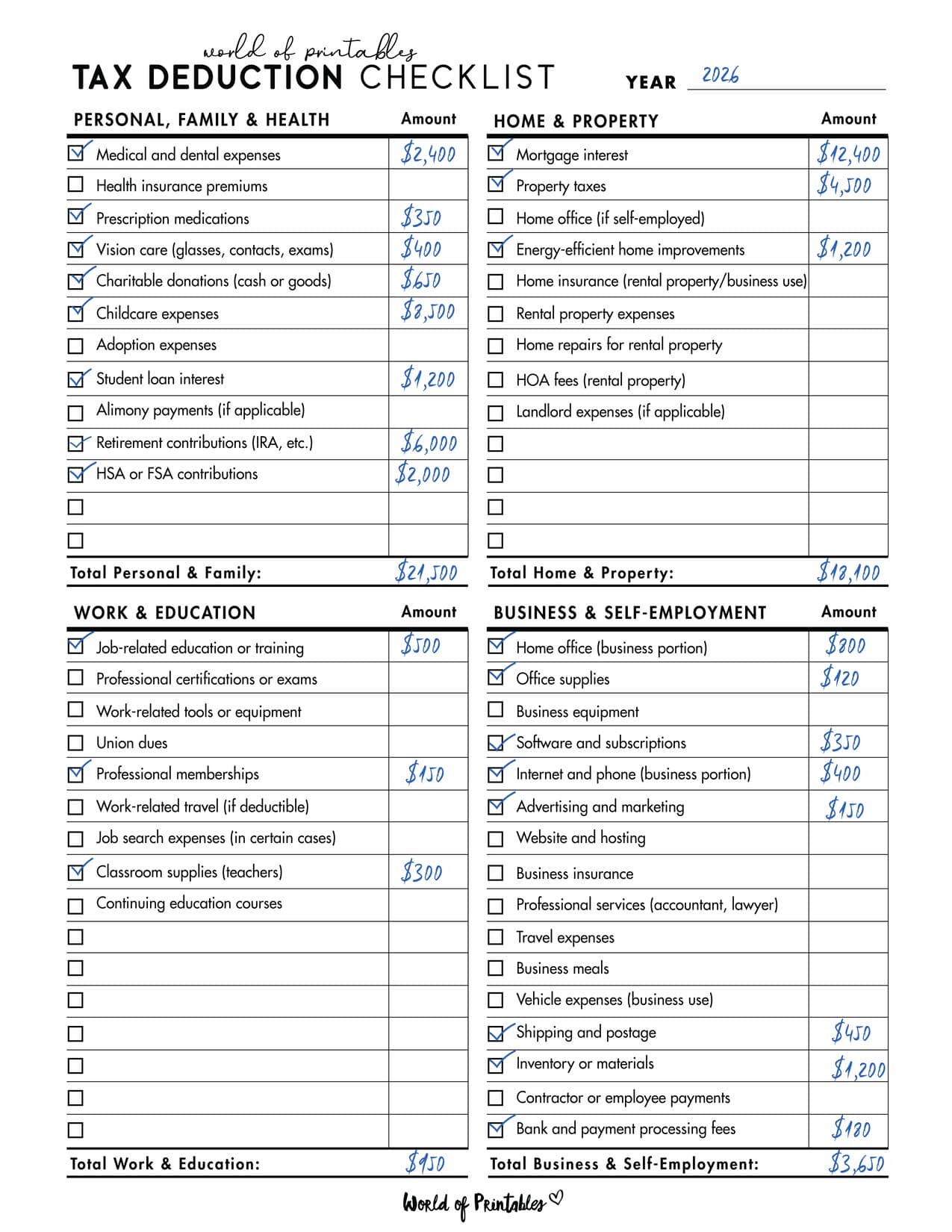
Here is the easiest way to use it:
Step 1: Set up your tax section
Start by creating a dedicated space for your tax-related paperwork.
This might be:
- a section in your budget binder
- a labeled folder
- a clear plastic sleeve behind the checklist
- a filing envelope for receipts and forms
The goal is simple: when something tax-related comes in, it has one obvious home.
That one small habit makes a huge difference later.
Step 2: Review the categories early in the year
Before you actually need the checklist, take a few minutes to look through the categories and see which ones may apply to you.
Depending on your situation, that could include:
- home-related expenses
- medical expenses
- donations
- education expenses
- side hustle costs
- business supplies
- mileage or travel records
- childcare or dependent-related documents
- interest statements
- tax forms from work, banks, or investment accounts
You do not need to fill out everything. You just want to become familiar with what may matter for your own household.
That way, when something comes up, you are more likely to recognise it and keep it.
Step 3: Check off categories as you gather records
Once your system is set up, start using the checklist as a guide.
When you receive or collect something relevant, mark it on the page and store the paperwork behind it.
This could include:
- forms received
- receipts saved
- statements downloaded
- expenses logged
- donations recorded
This makes the checklist feel active and useful instead of just informational.
It also gives you a quick visual view of what you already have and what you may still need to find later.
Step 4: Use it to prepare for tax season
When tax season comes around, this page becomes your review sheet.
Go down the checklist and ask:
- Do I have the documents for each category that applies to me?
- Have I kept the supporting receipts I may need?
- Are there any expenses I forgot to log?
- Is there anything I need to ask a tax professional about?
If you work with an accountant or tax preparer, this kind of organized setup can make things much smoother.
Instead of handing over a random pile of papers, you are handing over a clear, sorted file with a checklist at the front.
What to include on your Tax Deduction Checklist
A useful checklist should help you think broadly without becoming too technical or overwhelming.
Helpful sections often include:
- personal tax documents
- income forms
- home and property records
- medical and healthcare costs
- charitable donations
- education expenses
- child or dependent-related items
- business or side hustle expenses
- notes or follow-up questions
The exact categories that matter will depend on your household, but the goal is the same: keep the possible deduction areas visible so they are easier to track.
A few examples of what this page can help you stay on top of
This printable is especially useful for people who may have a mix of records throughout the year.
For example:
If you own a home
You may want to keep home-related documents and statements together.
If you run a side hustle
This page can remind you to keep track of things like supplies, subscriptions, office-related purchases, mileage logs, and receipts.
If you have ongoing medical costs
A checklist can help you stay aware of out-of-pocket costs, prescriptions, appointments, and related records.
If you donate regularly
This page gives you a place to remember donation receipts and charity records rather than trying to reconstruct them later.
The point is not that every category will apply to everyone. It is that the checklist helps you spot what does apply before it slips through the cracks.
Why this works so well in a budget binder
A Tax Deduction Checklist fits beautifully into a budget binder because it creates a bridge between everyday organization and tax season preparation.
It works especially well alongside:
- medical expense trackers
- donation logs
- monthly budget planners
- expense trackers
- annual financial summaries
- income and side hustle records
Those pages help you track the details.
The checklist helps you gather them with purpose.
That is what makes it such a good “front of section” page. It gives structure to the rest of your tax prep paperwork.
A simple tip that makes this page much more useful
Do not use this printable on its own.
Pair it with a pocket, sleeve, or folder directly behind it.
That way, the checklist becomes the front page of a complete tax-prep section instead of just a reminder list. As documents come in, they go straight behind the page. It is such a simple setup, but it makes tax season feel much less chaotic.
Next Step: Build Your Complete Financial Command Binder
A Tax Deduction Checklist helps you know what to watch for, but it works even better when it is supported by dedicated tracking pages.
Helpful pages to add next include:
- a medical expense tracker
- a donation and charity log
- a monthly budget planner
- an annual financial goals worksheet
- a year-end financial summary
Together, these pages help you stay more organised throughout the year, so tax season feels less like a scramble and more like a tidy review of information you already have.
Complete your tax-prep system by adding the next essential tracking tools to your binder:
- Return to the Ultimate Budget Binder Index.
- Capturing healthcare deductions? Download the Medical Expense Tracker to log out-of-pocket costs and HSA/FSA spending.
- Writing off your generosity? Download the Donation & Charity Log to audit-proof your 501(c)(3) contributions.
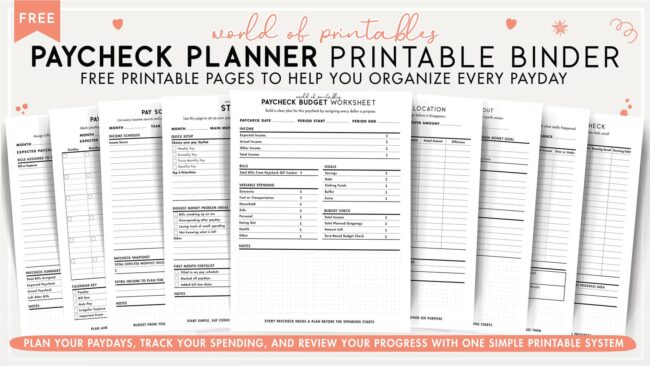
Tracking deductible expenses is important, but so is staying on top of the everyday money flow around them. Our Paycheck Planner helps you organize bills, spending, and paydays so your financial planning feels more complete.
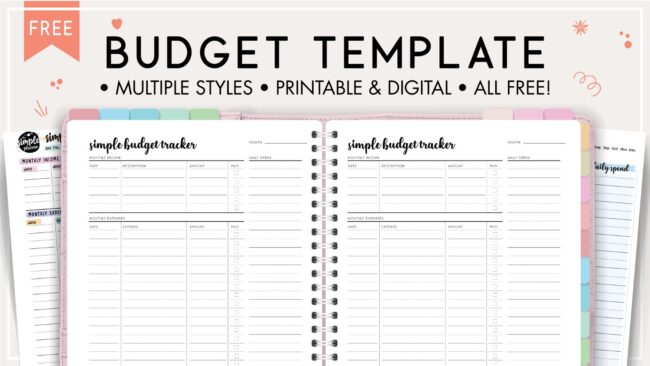
More budgeting templates
You’ll find many more budgeting templates right here on World of Printables.


AI TRANSPARENCY: Whilst the majority of our creations have been created completely traditionally, occasionally we utilize AI tools in our design process. We acknowledge the advancements in AI technology and leverage them responsibly to optimize our creative output. However, it is important to note that our utilization of AI does not compromise the human element of our work. Our commitment to delivering high-quality designs through a balanced integration of traditional expertise and AI enhancements remains paramount.